
HiLetgo 3pcs ESP8266 ESP-01
4.2Editor score
Three Pack Value
AP STA and AP+STA Modes
Compact Serial Transceiver
Discover the top Arduino WiFi Module options for 2026. This guide compares features, connectivity, and performance to help you choose the right wireless board.
Choosing the right Arduino WiFi Module is crucial for modern IoT projects. You need reliable connectivity, strong signal strength, and easy integration with your existing setup to ensure your devices communicate effectively.
We evaluated ten leading options based on connectivity standards, processing power, and community support. Our analysis focuses on real-world performance, ease of use, and compatibility with popular development environments.
Each pick highlights specific strengths for different project needs. Please note that availability and pricing can fluctuate over time, so always verify current details before making your final purchasing decision.
4.2Editor score

4.7Editor score

4.7Editor score
The following table provides a side-by-side comparison of all ten products to help you quickly identify the best fit for your specific project requirements and technical constraints.



The Arduino UNO R4 WiFi stands out as the top choice for enthusiasts wanting power and connectivity. It combines a Renesas microcontroller with an ESP32-S3 for robust performance and wireless features.
We may earn a commission when you buy through this link, at no additional cost to you.
Its dual-core architecture allows for complex tasks like edge AI while maintaining stable Wi-Fi and Bluetooth connections. The integrated 12×8 LED matrix provides immediate visual feedback without extra hardware.
While the cost is higher than basic modules, the included CAN bus and 12-bit DAC make it worth it for industrial or high-precision projects. The USB-C port ensures modern connection standards are met.
You should choose this board if you need reliable wireless communication and advanced processing capabilities in a single package. It is ideal for prototyping complex IoT systems.
The combination of Renesas RA4M1 and ESP32-S3 delivers powerful processing for high-speed communications and real-time data processing.
Robust wireless communication with Wi-Fi and Bluetooth 5.0 ensures stable operation for smart devices and remote sensors.
We may earn a commission when you buy through this link, at no additional cost to you.
This three-pack offers excellent value for beginners needing multiple units for large sensor arrays. The ESP8266 chip provides reliable wireless connectivity at a very low cost.
We may earn a commission when you buy through this link, at no additional cost to you.
You can use AP, STA, or AP+STA modes to customize network behavior for different project needs. The modules are small enough to fit into tight spaces on a breadboard.
Keep in mind you may need a level shifter since the board operates at 3.3V. Careful wiring ensures longevity and prevents damage to the sensitive components.
If you are working on a tight budget or need backups for many sensors, this pack is a practical solution. It is a great entry point into ESP8266 projects.
Supports 3 modes including AP, STA, and AP + STA for flexible wireless connectivity options.
A compact wireless transceiver module that fits easily into various development setups and projects.
We may earn a commission when you buy through this link, at no additional cost to you.
The ELEGOO ESP-32 boards deliver premium performance with a dual-core processor running at 240 MHz. This speed is excellent for data-intensive tasks and complex logic.
We may earn a commission when you buy through this link, at no additional cost to you.
Built-in Wi-Fi and Bluetooth allow for versatile connectivity. The USB-C port simplifies programming and power delivery compared to older micro-USB standards.
Low-power operating modes help extend battery life in portable devices. Over-the-air updates make maintaining firmware on deployed projects much easier than wired updates.
Choose this board when you need high processing power and modern connectivity features. It is suitable for professional IoT applications and advanced home automation.
Dual-core performance up to 240 MHz runs sensor processing and wireless communication efficiently.
Built-in Wi-Fi and Bluetooth 4.2 connect to networks or wireless sensors seamlessly.
We may earn a commission when you buy through this link, at no additional cost to you.
This module features 4MB of flash memory which allows for storing larger scripts and firmware. It is an updated version with improved signal strength over older models.
We may earn a commission when you buy through this link, at no additional cost to you.
Program it using the Generic ESP8266 Module option in Arduino IDE. The updated design ensures better compatibility and stability during wireless transmission.
Handling requires care due to its small size and sensitivity to static. Use a USB adapter for safe connection and flashing of code.
It is a strong contender for standard IoT projects requiring reliable memory and signal. Ideal for hobbyists who need more storage than basic boards offer.
Features 4MB Flash Memory to store more data and firmware than standard 1MB modules.
Latest version esp-01s provides stronger signal and improved performance.
We may earn a commission when you buy through this link, at no additional cost to you.
This five-pack is ready for bulk sensor deployments. The ESP-01 modules support standard AT commands for easy configuration and testing.
We may earn a commission when you buy through this link, at no additional cost to you.
Ensure you supply only 3.3V as these modules do not handle 5V logic. The small size helps in space-constrained designs.
Compatibility with NodeMCU and Arduino makes coding straightforward. You can use these for basic IoT projects like weather stations.
Buy this if you need a reliable set of transceivers for multiple devices. It is perfect for classrooms or workshops needing spare units.
Widely used in smart grids, intelligent transportation, and industrial control.
Ready for Arduino, NodeMCU, and AT+Commands usage.
We may earn a commission when you buy through this link, at no additional cost to you.
The Nano ESP32 packs a powerful ESP32-S3 chip into a small form factor. It supports Python which is great for rapid prototyping and scripting.
We may earn a commission when you buy through this link, at no additional cost to you.
HID support allows it to act as a keyboard or mouse. This opens up unique input device possibilities beyond typical sensor monitoring.
Note that it ships without headers so you must solder them. This adds a step but keeps the board flat for production.
Choose this for advanced projects needing Python support or custom input devices. It fits well in wearables and compact IoT units.
Powered by ESP32-S3 with up to 240 MHz processor.
MicroPython Compatible for easy and rapid prototyping.
We may earn a commission when you buy through this link, at no additional cost to you.
This pack contains four modules made of good material that can be reused. They are suitable for wearable electronics and wireless location sensing.
We may earn a commission when you buy through this link, at no additional cost to you.
The self-calibrated RF ensures optimal performance for transmission. You can use them for home automation networks easily.
They are standard ESP8266 modules with no extra features. Keep them away from high humidity environments to maintain quality.
Ideal for small teams needing consistent performance. Use them where simple reliable connectivity is the main requirement.
Self-calibrated RF ensures optimal performance for wireless scenarios.
Made of good material allowing multiple reuses.
We may earn a commission when you buy through this link, at no additional cost to you.
These five modules come with 4MB flash for ample data storage. The DOUT protocol allows for standard SPI programming modes.
We may earn a commission when you buy through this link, at no additional cost to you.
Ensure you use 3.3V power to avoid damage. The baud rate is typically set to 115200 for communication.
Use the generic ESP8266 module board setting in your IDE. This helps with successful code uploads.
A great option for data logging projects needing space. Buy this if you need to store logs locally on the device.
Flash: 4MB provides ample on-board storage for data retention.
The 01S is DOUT protocol suitable for standard programming.
We may earn a commission when you buy through this link, at no additional cost to you.
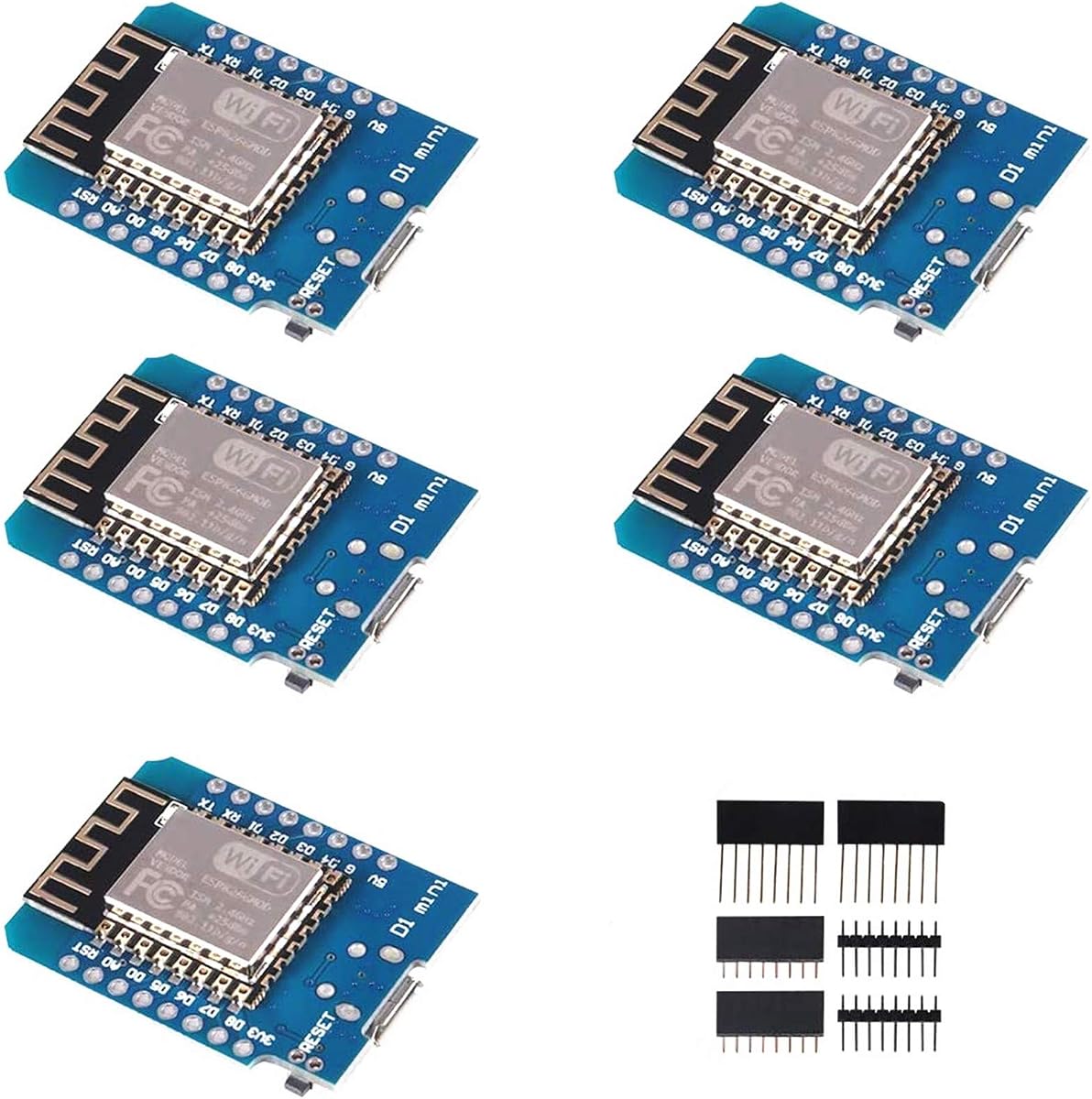
These boards are Mini NodeMcu Lua WiFi boards based on ESP8266EX. They offer 11 digital IO pins for various sensor connections.
We may earn a commission when you buy through this link, at no additional cost to you.
You can program using Arduino IDE or Lua. The board includes a USB connection for power and programming.
Each pin supports interrupts and PWM. Keep in mind the 500mA fuse limits current draw.
Perfect for developers who prefer Lua scripting. Use these for smart home controllers needing many outputs.
11 digital input / output pins with interrupt support.
Compatible with Arduino WeMos and Lua programming.
We may earn a commission when you buy through this link, at no additional cost to you.
This bulk pack is ideal for large scale deployments. With a perfect rating, users trust its robust processing and storage.
We may earn a commission when you buy through this link, at no additional cost to you.
LWIP in AP+STA mode streamlines development for networking. It offers versatile options for access point and client modes.
The compact design allows for easy integration into devices. Use these for commercial projects needing reliable connectivity.
Buy this for maximum value and quantity. Ensure you have adapters ready for safe voltage levels.
Supports three distinct WiFi operation modes including AP+STA.
Boasts robust on-board processing for complex tasks.
We may earn a commission when you buy through this link, at no additional cost to you.
Selecting the right module depends on your specific project requirements such as power needs and network complexity. This guide highlights key factors to consider.
Most modules run on 3.3V so ensure your power supply matches. Higher voltage can damage the chip immediately.
Always use a voltage regulator or level shifter to protect the module during development.
Check if the module supports AP STA or AP+STA modes. AP mode allows clients to connect to your board.
STA mode connects the board to existing Wi-Fi networks.
Dual-core boards like the ESP32 handle complex logic better than single-core ones. Consider if you need to process data on the device.
Higher speed is beneficial for real-time applications.
Modules with 4MB flash allow for larger programs and data logging. Basic modules have less storage.
Choose higher memory if you plan to store logs or scripts.
Modules with external antennas or better RF calibration offer better range. Some are sensitive to placement.
Test signal strength if you plan to deploy in large areas.
Ensure the module is compatible with the Arduino IDE or MicroPython. Some need specific board managers.
Popular modules have extensive community documentation.
Look for USB-C if you want modern connections. Micro-USB is common on older boards.
Modern connectors are more durable and easier to use.
Advanced boards include CAN bus or DAC features. These add value for industrial projects.
Choose feature-rich boards if you need analog outputs.
Start by connecting the module to your computer via USB adapter. Ensure drivers are installed for serial communication.
Upload test sketches to verify wireless connection works. Use the serial monitor to check debug messages.
Store modules in dry anti-static bags when not in use to prevent damage from moisture or static.
Yes you can add the ESP8266 board manager URL in preferences and install it. Then select the ESP01 board to upload code.
Most ESP modules are 3.3V only. You must use level shifters to safely connect them to 5V Arduino pins.
Typically 30 meters indoors and 100 meters outdoors depending on environment. Antenna quality plays a big role.
Install the ESP32 board manager in Arduino IDE. Select your specific board and upload code via USB.
Yes they are standard choices for smart home devices due to Wi-Fi support and low cost. Many libraries exist for control.
It allows updating firmware over Wi-Fi without USB connection. This is useful for deployed devices.
We found the Arduino UNO R4 WiFi to be the top pick for power and features. The ESP8266 packs offer great value for budget projects.
Prioritize power handling and connectivity modes based on your needs. Ensure your power supply is stable for reliable operation.
Prices and availability can vary so check current listings before you buy. The right module makes your project succeed.
