
Bambu Lab A1 Mini Combo
4.2Editor score
Multi-color printing ready
Full auto calibration
Quiet operation mode
Finding the right 3D printer for Dnd miniatures can transform your tabletop gaming experience. Whether you need intricate details or fast production, choosing the correct machine matters greatly for quality results.
We evaluated ten leading printers based on resolution, speed, and ease of use. Our analysis focuses on models that deliver sharp details suitable for painted miniatures and functional game pieces.
Each pick highlights key strengths and ideal use cases for different budgets. Remember that pricing and availability change frequently, so check current listings before making your final purchasing decision today.
4.2Editor score

4.4Editor score

4.5Editor score
As an Amazon Associate we earn from qualifying purchases.
This side-by-side comparison helps you visualize the strengths of each model. We highlight key specs like build volume, resolution, and unique features to simplify your decision process.






The Phrozen Sonic Mini 8K S stands out as an exceptional choice for printing highly detailed miniatures. With its 22 micron XY resolution and 8K mono LCD, it captures fine lines and textures essential for tabletop gaming figures. Users appreciate its beginner friendly design which lowers the entry barrier for those new to resin printing.
We may earn a commission when you buy through this link, at no additional cost to you.
Key strengths include its precise Z axis calibration which ensures consistent layer adhesion and smooth surfaces. The compact yet powerful build allows for substantial print volume without taking up too much workspace. Support for open source software gives users flexibility to choose their preferred slicers like Lychee or Chitubox for optimal results.
While the machine excels at detail, it does require handling liquid resin which involves safety precautions and post processing steps like washing and curing. This trade-off is acceptable for those seeking top tier print quality for miniatures. The need for additional equipment like UV lights and washing stations adds to the initial setup complexity.
This printer is ideal for hobbyists who prioritize detail over speed and are willing to manage resin printing workflows. It delivers professional grade results for Dungeons and Dragons miniatures and action figures. For those ready to invest in the resin ecosystem, this model offers a reliable path to stunning custom game pieces.
The 22 micron resolution ensures even the smallest facial features and armor details remain crisp and defined.
Open source support allows you to use your favorite slicers and customize settings without vendor lock-in.
We may earn a commission when you buy through this link, at no additional cost to you.
The Bambu Lab A1 Mini Combo offers an affordable entry point into high quality FDM printing with multi-color capabilities. Its inclusion of the AMS lite system allows for vibrant prints without manual filament swaps. The printer is designed for ease of use with full auto calibration that eliminates common bed leveling issues.
We may earn a commission when you buy through this link, at no additional cost to you.
Speed and precision are notable strengths with acceleration up to 10,000 mm/s2 ensuring rapid print times. The active motor noise canceling technology makes it suitable for home or office environments where noise levels matter. Setup is streamlined with a pre-assembled design that gets you printing in just 20 minutes.
While the build volume is smaller than full size models, it remains sufficient for most miniature and small prop projects. The requirement to purchase the AMS lite separately if not in the combo adds to the total cost slightly. However the overall value for multi-color printing remains strong for the price point.
This model is perfect for beginners or small studios needing color without complexity. It balances cost and performance effectively for creating detailed game pieces. For those wanting to print colorful miniatures without mastering manual swapping, the A1 Mini Combo is a solid budget friendly recommendation.
The AMS lite enables vibrant multi-color prints that bring fantasy characters to life with ease.
Active noise cancellation ensures the printer runs quietly so it does not disturb your workspace.
We may earn a commission when you buy through this link, at no additional cost to you.
The Snapmaker U1 represents the pinnacle of FDM technology with its four independent toolhead system enabling true multi-material and multi-color prints. This reduces waste significantly compared to traditional purge-based systems. The 5 second tool changer ensures minimal downtime between material switches maintaining a seamless workflow for complex projects.
We may earn a commission when you buy through this link, at no additional cost to you.
Its rigid CoreXY motion system with carbon fiber rails supports speeds up to 500 mm/s without sacrificing accuracy. The large build volume of 270 x 270 x 270 mm accommodates larger props and multiple miniatures in one print. Smart calibration features ensure first layer perfection and dimensionally accurate prints out of the box.
The high price point and complexity of managing four toolheads may deter casual hobbyists. However for professionals or serious enthusiasts the productivity gains are substantial. The ability to mix rigid and flexible materials in one print opens up creative possibilities for articulated figures and custom parts.
This printer is best suited for advanced users who need reliability and versatility. It transforms multi-color printing from a chore into a smooth automated process. If budget allows the Snapmaker U1 delivers unmatched performance for high-end tabletop gaming production needs.
Tool swapping instead of filament purging cuts waste by up to 5X saving material costs.
Combine rigid body parts with flexible joints or soluble supports in a single print job.
We may earn a commission when you buy through this link, at no additional cost to you.
The Bambu Lab A1 delivers unparalleled speed and precision with acceleration reaching 10,000 mm/s2. This FDM printer maintains exceptional accuracy for detailed miniatures while printing incredibly fast. Full auto calibration ensures optimal performance every time without manual intervention saving you valuable setup time.
We may earn a commission when you buy through this link, at no additional cost to you.
Active flow rate compensation guarantees smooth prints by adjusting extrusion based on real-time readings. The 1-Clip quick swap nozzle makes maintenance convenient and versatile printing options accessible. Its user-friendly interface and simplified touchscreen make it ideal for beginners or even young users.
While the machine is excellent multi-color printing requires the AMS lite which must be bought separately. The build volume is also compact which may limit larger projects. However for most miniature needs these constraints are acceptable given the overall performance.
This printer is perfect for those wanting speed and ease without compromising quality. It streamlines the workflow for creating fantasy miniatures and props. If you value efficiency and reliability the A1 offers a robust solution for desktop manufacturing.
High acceleration maintains precision so you can print complex models in minutes not hours.
Z-offset and bed leveling happen automatically so every print starts with a perfect first layer.
We may earn a commission when you buy through this link, at no additional cost to you.
The Bambu Lab P2S Combo combines a high speed FDM printer with the AMS 2 Pro for seamless multi-color production. It prints up to 600 mm/s while maintaining sharp corners and consistent results. AI failure detection and quick swap nozzles make professional printing accessible to beginners.
We may earn a commission when you buy through this link, at no additional cost to you.
Adaptive airflow management balances cooling and heat retention for overhangs and engineering materials. The AMS 2 Pro includes built-in filament drying keeping spools ready for flawless prints. This feature ensures material integrity especially for hygroscopic filaments used in detailed models.
While the price is higher the combo delivers a unified workflow from design to finished print. The need for the AMS module adds to cost but unlocks multi-color capabilities. This investment is justified for users needing volume and variety in their outputs.
Ideal for hobbyists or small businesses scaling their printing operations. It reduces downtime and increases consistency across batches. For those wanting a powerful tool capable of handling diverse materials and colors the P2S Combo is a top contender.
Built-in drying prevents moisture issues ensuring consistent quality across all your prints.
Airflow adjusts automatically to suit different materials for crisp overhangs and smooth surfaces.
We may earn a commission when you buy through this link, at no additional cost to you.
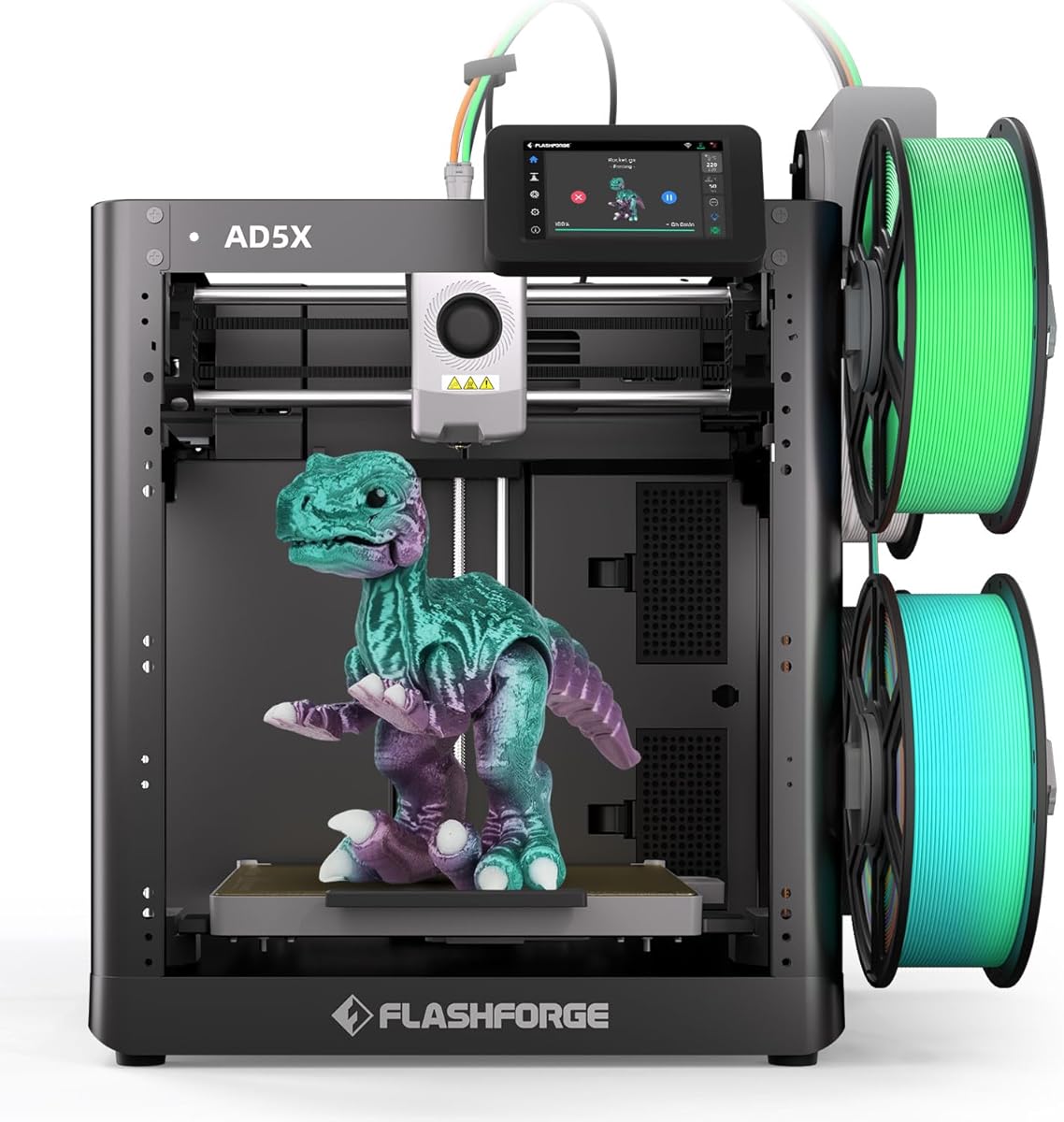
The FLASHFORGE AD5X offers vibrant multi-color printing with up to four colors simultaneously using its Intelligent Filament System. This enhances creativity for intricate designs and allows users to produce visually stunning models. The IFS automatically detects and refills filament minimizing downtime during long jobs.
We may earn a commission when you buy through this link, at no additional cost to you.
Performance is strong with speeds up to 600 mm/s and acceleration of 20,000 mm/s2. The all-metal Core XY structure minimizes vibrations for accurate prints regardless of complexity. Its large size supports diverse tasks from prototypes to artistic pieces.
While the rating is lower than some competitors the feature set is compelling for the price. The system is designed for efficiency and ease of use. Newer models may have teething issues but the core performance remains solid.
This printer suits artists and designers needing colorful outputs without manual swaps. It balances speed and capability well for hobbyist use. For those wanting multi-color capability on a budget the AD5X is an attractive option.
Create eye-catching miniatures with multiple colors in a single print for enhanced visual impact.
Automatic refill keeps prints going so you do not have to monitor the machine constantly.
We may earn a commission when you buy through this link, at no additional cost to you.
The Bambu Lab P1S features a fully enclosed body that improves performance for advanced filaments like ABS and ASA. It supports up to 16 colors when connected to an AMS unit. Auto bed leveling ensures high quality successful prints without manual calibration.
We may earn a commission when you buy through this link, at no additional cost to you.
With speeds up to 500 mm/s and acceleration of 20000 mm/s2 printing is lightning fast. Setup takes only 15 minutes so you spend more time creating. The user-friendly design ensures a hassle-free experience for all skill levels.
The enclosed design is crucial for printing warping-prone materials which are often needed for durable miniatures. However it does not recommend carbon or glass fiber reinforced polymers. This limits some engineering applications but covers most hobby needs.
This model is ideal for makers needing material versatility and speed. It handles functional parts and detailed miniatures with ease. For those wanting a robust machine that grows with your skills the P1S is a smart investment.
The enclosure allows reliable printing of strong engineering materials for durable game pieces.
Connect an AMS to enable up to 16 colors for stunning customized miniatures.
We may earn a commission when you buy through this link, at no additional cost to you.
The Adventurer 5M Pro stands out for its quiet operation under 50dB making it ideal for shared spaces. Its all-metal CoreXY frame with vibration compensation ensures smooth surfaces and precise details. A dual filtration system keeps the air clean and the enclosure maintains thermal stability.
We may earn a commission when you buy through this link, at no additional cost to you.
Printing speed reaches 600 mm/s with integrated algorithms eliminating ghosting. The quick swap nozzle allows effortless replacements in 3 seconds. Mobile control and camera monitoring give you remote access and time-lapse creation capabilities.
While not the highest rated the combination of features is strong for home use. The high-temp extruder handles engineering materials reliably. Filament detection and power recovery provide peace of mind during long prints.
Perfect for office or classroom environments where noise and safety matter. It offers professional features in a user-friendly package. For those prioritizing quiet operation and convenience the Adventurer 5M Pro delivers.
Quiet motors ensure your workspace remains peaceful while the printer runs unnoticed.
View progress and adjust settings from your phone without needing to stay near the machine.
We may earn a commission when you buy through this link, at no additional cost to you.
The AD5X Multi-Material brings vibrant 4-color printing to a compact modular design. Its all-metal CoreXY structure offers high rigidity reducing vibration errors. The intelligent filament system allows printing multiple colors and materials simultaneously enhancing versatility.
We may earn a commission when you buy through this link, at no additional cost to you.
Full auto leveling ensures consistent first layer adhesion every time. Vibration suppression algorithms minimize layer shifts for higher overall quality. The design saves significant space while accommodating four spools side by side.
While the IFS may need DIY setup the productivity boost is clear. It supports a wide range of materials from PLA to carbon fiber blends. The space-saving footprint is a major plus for small studios.
This printer suits creators needing color and compact footprint. It is efficient for diverse projects without sacrificing much capability. For those needing a compact multi-color solution the AD5X is a strong choice.
Modular design fits easily into small desks while supporting four colors and flexible materials.
Auto leveling sensors ensure perfect adhesion so you spend less time fixing failed prints.
We may earn a commission when you buy through this link, at no additional cost to you.
The Anycubic Kobra X comes native with 4 colors eliminating the need for complex add-ons. Its hardened steel nozzle and vibration compensation ensure every layer remains smooth. LeviQ 3.0 auto bed leveling provides perfect first layers 15 minutes after pickup.
We may earn a commission when you buy through this link, at no additional cost to you.
It reduces filament waste by minimizing travel paths during color changes. Smart AI monitoring detects foreign objects and spaghetti issues. A vast library of over 100,000 models helps users find inspiration and designs quickly.
Filament is not included so initial cost may seem higher. The system offers great connectivity with Wi-Fi for remote control. It is built for versatility supporting mixed rigid and flexible materials.
This printer is excellent for hobbyists wanting quick color results without third-party tools. It is scalable with expansion options to 19 colors. For those valuing native multi-color and smart features the Kobra X stands out.
Built-in spool holders make switching colors easy without external modules or complex setups.
AI monitoring watches the print to catch errors early and save time and material.
We may earn a commission when you buy through this link, at no additional cost to you.
Selecting the right printer involves balancing resolution, speed, and material type. This guide breaks down key factors to help you make an informed decision for your gaming needs.
Resolution defines how fine the details will be in your miniatures. FDM printers typically offer layer heights around 50 to 200 microns which can be enough for base miniatures. Resin printers provide much higher XY resolution often below 50 microns ideal for intricate facial and armor details.
Look for printers with fine XY resolution or low layer height settings if you plan to paint and display miniatures prominently.
FDM printers use filament spools making them safer and easier to handle for general use. Resin printers use liquid resin which offers better detail but requires more safety equipment and cleanup.
Choose FDM for durability and ease or Resin for maximum detail if you are willing to handle the extra processing.
The build volume determines how many miniatures you can print at once. Larger volumes save time but require more space on your desk. Check dimensions to ensure you can fit the models you intend to create.
Prioritize a volume that matches your typical batch size to avoid multiple prints for a single game session.
Multi-color printing adds life to miniatures but often requires additional modules or systems. Some printers have native color spool holders while others need an external system like AMS or IFS.
Decide if you need multi-color output and factor in the cost of any required accessories before buying.
Print speed affects how quickly you can produce miniatures for your group. High-speed models use advanced calibration and motion systems to reduce print times drastically.
Look for printers with high acceleration and auto leveling to maximize uptime and reduce waiting periods.
Auto calibration features save time and prevent failed prints. Systems that handle bed leveling and flow compensation automatically are ideal for beginners.
Choose a model with reliable calibration to ensure consistent results without constant tweaking or adjustment.
Noise can be a factor if you print in shared living spaces. Some printers offer noise cancellation or operate below 50dB.
Consider the sound profile if the printer will be used in bedrooms or offices where quiet is important.
Ensure the printer supports the materials you need such as PLA for miniatures or PETG for durable props. Check temperature ranges for nozzles and beds.
Select a printer with broad material support to expand your creative options as your hobby grows.
Start by reading the manual and calibrating the bed according to the manufacturer instructions. Use high-quality filaments or resins and store them in dry environments to prevent moisture absorption and print defects.
Keep the nozzle clean and replace it when clogs occur or wear is evident. For resin printers ensure proper ventilation and wear gloves when handling liquid resin for safety.
Regularly update firmware and slicer software to access new features and bug fixes. Perform routine maintenance like tightening belts and lubricating rods to extend the printer lifespan.
Resin printers generally offer finer detail due to higher XY resolution. However modern FDM printers can also produce good results with fine nozzle settings and proper calibration.
Some printers include proprietary slicers but open source options like Cura or Lychee offer more control. Check compatibility to ensure you can slice models effectively.
Multi-color printing requires a system with multiple spools like AMS or IFS. This allows color swaps without manual intervention reducing waste and effort.
Yes most FDM printers support TPU and flexible filaments. Ensure you have a direct drive extruder for better handling of these materials.
For resin printers use nitrile gloves and goggles. FDM printers need ventilation if using ABS or similar materials. Always work in well-ventilated areas.
Check belts and motors every few weeks and replace nozzles when prints degrade. Clean the bed and check for filament jams regularly.
Yes many models feature auto calibration and intuitive interfaces. Start with simpler tasks and gradually explore complex prints as you gain confidence.
Websites like Thingiverse and Cults3D offer free files. Slicers often include libraries for ready-made models to test your printer.
We explored ten excellent printers offering diverse features for miniature enthusiasts. From the detailed precision of the Phrozen Sonic Mini 8K S to the speed and simplicity of the Bambu Lab A1 there is a model for every need.
Prioritize resolution and speed based on how you plan to use your miniatures. If multi-color is important consider models with native systems or reliable add-ons to streamline your workflow.
Remember to verify current prices and availability before purchasing. Technology advances quickly so check for the latest firmware and updates to ensure you get the best performance.