This expert guide compares the top Arduino ADC boards for precision analog-to digital conversion. Learn about features like resolution, channel count, and
As an Amazon Associate we earn from qualifying purchases. We may earn a commission when you buy through links on this page, at no additional cost to you. Read our affiliate disclosure.As an Amazon Associate we earn from qualifying purchases.Purchases through our links may earn us a commission, at no extra cost to you. Read our affiliate disclosure.
Selecting the right analog to digital converter is crucial for any embedded system project requiring precise sensor readings. An Arduino ADC board bridges the gap between analog signals and digital microcontrollers, enabling accurate measurement of voltage, current, and other physical phenomena. Whether you are building a weather station or monitoring industrial equipment, the quality of your ADC directly impacts data reliability.
We have carefully evaluated ten leading ADC modules available on the market to help you make an informed decision. Our comparison focuses on resolution, sampling rates, channel configurations, and compatibility with popular platforms like Arduino and Raspberry Pi. Each product was analyzed based on its technical specifications, user feedback, and suitability for various application scenarios.
Each review in this guide highlights specific strengths and potential limitations to give you a clear picture of what to expect. You will find detailed breakdowns of features, pros, and cons for every product listed. Please note that pricing and availability can change frequently, so we recommend checking the current listings before making your final purchase decision.
Top 3 Picks for Best Arduino ADC Board
Best Budget
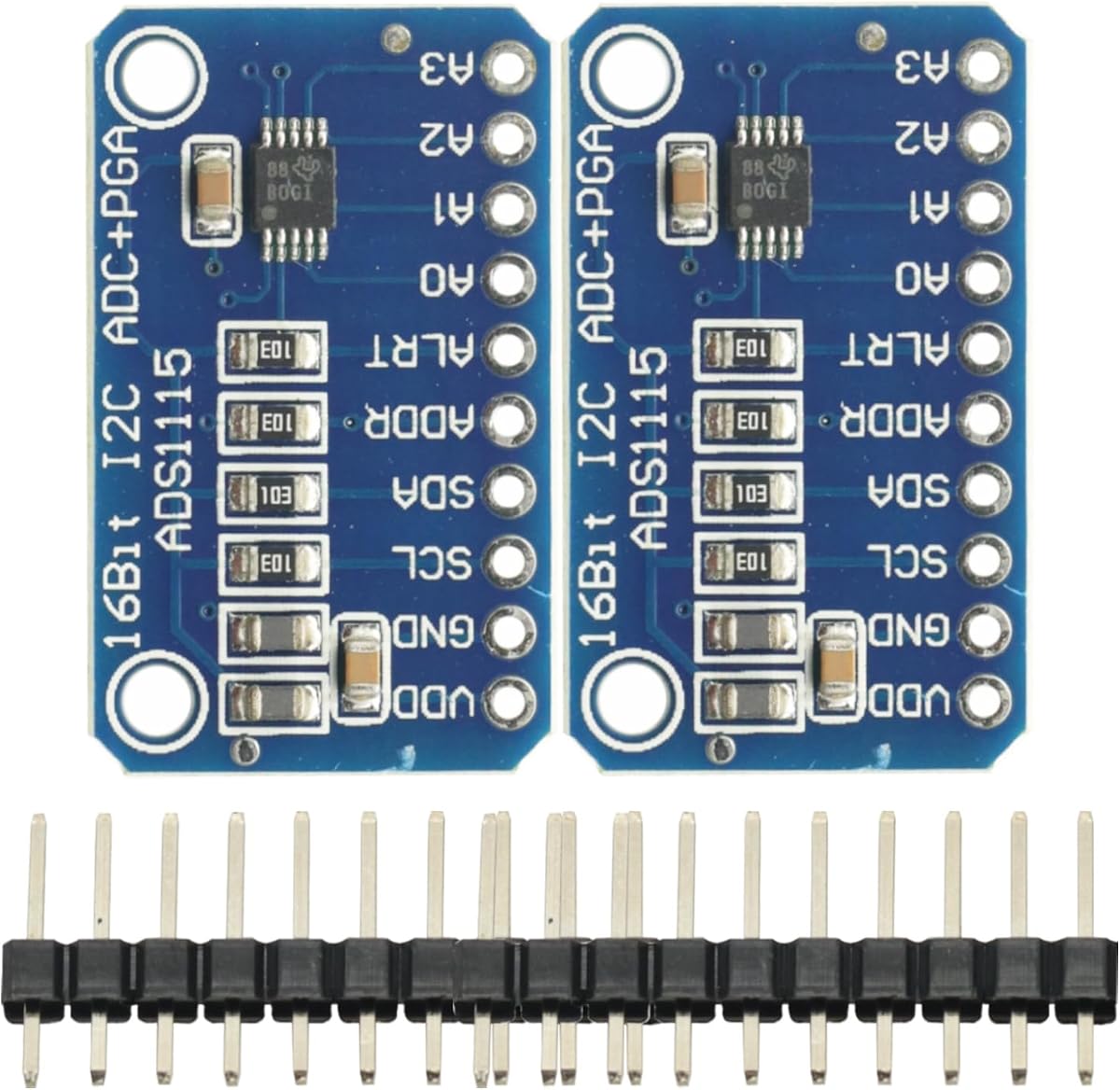
2Pcs ADS1115 16 Bit I2C Module Precision ADC 4 Channel Analog-to-Digital Converter Development Board Pro Gain Amplifier for Arduino Raspberry Pi ADC Module
The following table provides a side by side comparison of all ten products reviewed in this guide. It highlights key specifications such as bit resolution, number of channels, communication protocols, and unique features to help you quickly identify the best fit for your specific project requirements.
Teyleten Robot ADS1115 16 Bits 4 Channel Analog-to-Digital Converter Precised Develop Board Module Amplifier Board ADC I2C IIC for Arduino Raspberry Pi (Pack of 3pcs)
16 bit resolution
I2C interface support
2.0V to 5.5V range
860 samples per second
This Teyleten Robot ADS1115 module stands out as a top choice for developers needing precise analog conversion with Arduino and Raspberry Pi systems. With a solid rating of 4.7 stars, it offers 16 bit resolution across four channels, making it ideal for detailed sensor measurements and data acquisition tasks.
Pros
High resolution accuracy
Multiple channel options
Wide voltage compatibility
Programmable data rate
Auto shut down feature
Cons
Small board size
Soldering required headers
We may earn a commission when you buy through this link, at no additional cost to you.
The module features a programmable gain amplifier that allows you to adjust input ranges for better sensitivity. It supports data rates from 8 to 860 samples per second, providing flexibility for both slow moving environmental sensors and faster signal processing applications. The I2C interface simplifies wiring and reduces pin usage on your microcontroller.
While the board is compact, which is great for space constrained projects, it may require careful soldering if headers are not pre installed. The auto shut down mode helps conserve power, which is beneficial for battery operated devices. Overall, the combination of precision and ease of use makes it a reliable component for hobbyists and professionals alike.
If you are looking for a versatile ADC that balances performance and price, this module is highly recommended. It is suitable for projects involving temperature monitoring, voltage sensing, or any application requiring high fidelity analog data. The pack of three ensures you have spares for multiple prototypes or distributed systems.
Precision Measurement Capabilities
The 16 bit resolution ensures that even small voltage changes are captured accurately, which is essential for sensitive sensors like thermocouples or strain gauges.
Flexible Communication Interface
Using I2C allows for easy daisy chaining of multiple modules, enabling you to expand your analog input capabilities without consuming additional digital pins on your board.
HiLetgo ADS1256 5V 8 Channel 24 Bit ADC Data Acquisition Board Module High Precision AD Collecting Data Acquisition Card
24 bit resolution
8 single ended inputs
30ksps data rate
±0.0010% nonlinearity
The HiLetgo ADS1256 module offers exceptional precision with its 24 bit resolution, making it a powerful tool for high accuracy data acquisition. It features eight channels that can be configured as single ended or differential inputs, providing versatility for various sensor configurations. The nonlinearity is impressively low at ±0.0010%, ensuring reliable and consistent readings.
Pros
Extremely high resolution
Low nonlinearity error
On board reference voltage
High sampling speed
SPI interface support
Cons
Requires careful wiring
More complex setup
We may earn a commission when you buy through this link, at no additional cost to you.
Equipped with an on board ADR03 2.5V datum voltage source, this module reduces the need for external reference components. The data output rates reach up to 30ksps, which is suitable for dynamic signal monitoring. The SPI communication protocol allows for high speed data transfer, though it requires more wiring than I2C solutions.
Users should note that the board is best suited for measuring analog voltage within 3V due to its internal design. The complexity of the SPI interface might be a slight hurdle for beginners compared to simpler I2C modules. However, the performance metrics make it a strong candidate for professional or advanced hobbyist projects.
This ADC is particularly useful for applications where signal fidelity is critical, such as audio processing or precise instrumentation. The high resolution allows for detecting minute changes in input signals that lower bit ADCs might miss. If your project demands top tier accuracy and speed, this module delivers on those fronts.
High Precision Engineering
The 24 bit architecture provides a massive dynamic range, enabling the detection of extremely small voltage variations that are vital for scientific and industrial measurements.
Stable Voltage Reference
Having an on board reference voltage simplifies the circuit design and improves stability, ensuring that measurements remain consistent over time and varying temperatures.
We may earn a commission when you buy through this link, at no additional cost to you.
3. 2Pcs ADS1115 16 Bit I2C Module Precision ADC 4 Channel Analog-to-Digital Converter Development Board Pro Gain Amplifier for Arduino Raspberry Pi ADC Module – Best Value Pick
2Pcs ADS1115 16 Bit I2C Module Precision ADC 4 Channel Analog-to-Digital Converter Development Board Pro Gain Amplifier for Arduino Raspberry Pi ADC Module
16 bit ADC
4 channels available
Programmable data rate
Wide input ranges
This pack of two ADS1115 modules has achieved a perfect 5.0 rating from users, highlighting its exceptional value and performance. Each board offers 16 bit resolution and four analog channels, making it a versatile choice for a wide range of projects. The programmable gain amplifier allows you to optimize sensitivity for different input levels.
Pros
Perfect user rating
Affordable pack price
Gain amplifier included
Multiple voltage ranges
Easy I2C integration
Cons
Limited to 16 bit
No external reference
We may earn a commission when you buy through this link, at no additional cost to you.
The input voltage range is flexible, operating between 2.0V and 5.5V, which ensures compatibility with various power supplies. You can select from seven different input ranges, allowing you to measure signals as low as ±0.256V or as high as ±6.144V. This flexibility is crucial for handling diverse sensor types without additional circuitry.
While it is limited to 16 bit resolution which is standard for this class of ADC, the trade off is an extremely competitive price point. The I2C interface makes it simple to connect to microcontrollers like Arduino or ESP32. The small form factor ensures it fits easily into breadboards and compact enclosures.
For educators or hobbyists looking to build multiple projects without breaking the bank, this is an excellent choice. The high user satisfaction suggests reliability and ease of use. It is particularly well suited for classroom labs, prototyping, and any project where cost effectiveness is a priority without sacrificing quality.
Cost Effective Performance
Getting two high quality ADC modules at this price point allows for extensive experimentation and multi unit deployment without the financial burden of more expensive alternatives.
Versatile Input Options
The ability to switch between different input ranges means you can use the same board for various sensors, from low voltage thermocouples to higher voltage industrial signals.
We may earn a commission when you buy through this link, at no additional cost to you.
4. HiLetgo 3pcs ADS1115 16 Bit 16 Byte 4 Channel I2C IIC Analog-to-Digital ADC PGA Converter with Programmable Gain Amplifier High Precision ADC Converter Development Board for Arduino Raspberry Pi – Detailed Analysis
HiLetgo 3pcs ADS1115 16 Bit 16 Byte 4 Channel I2C IIC Analog-to-Digital ADC PGA Converter with Programmable Gain Amplifier High Precision ADC Converter Development Board for Arduino Raspberry Pi
16 bit resolution
I2C ADC converter
Comparator mode support
Single shot mode
This three pack of ADS1115 boards from HiLetgo provides a convenient solution for those needing multiple units for a project. With a rating of 4.3, it offers high precision 16 bit conversion and a programmable gain amplifier to enhance signal quality. The wide voltage supply range ensures it works well with both 3.3V and 5V systems.
Pros
Good value for 3pcs
Wide voltage range
PGA amplifier included
Auto shut down
Compatible with Pi
Cons
Some quality variance
Basic documentation
We may earn a commission when you buy through this link, at no additional cost to you.
The module is particularly noted for its utility with Raspberry Pi, which lacks built in analog GPIO pins. The comparator mode helps maintain accuracy by allowing direct threshold comparisons without constant polling. The single shot mode with auto shut down is a great feature for battery powered devices that need to minimize power consumption.
While most users report satisfaction, there are occasional reports of minor quality variance between individual units in the pack. Documentation is standard but may require you to refer to datasheets for advanced configuration options. However, the core functionality remains robust for typical sensing and monitoring tasks.
If you need to equip several nodes in a distributed system, this pack is a practical option. The ease of use and standard I2C interface make it accessible even for beginners. It is a solid choice for home automation, environmental monitoring, or educational demonstrations where quantity is as important as quality.
Raspberry Pi Integration
This module fills a critical gap for Raspberry Pi users by providing a straightforward way to read analog sensors without needing complex additional hardware or GPIO expanders.
Power Management Features
The auto shut down capability in single shot mode extends battery life significantly, making it ideal for remote sensors that run on batteries for long periods.
This four piece set of ADS1115 converters offers a bulk option for large scale deployments or classroom use. It features 16 bit resolution with four channels that can be configured for differential or single ended inputs. The internal oscillator ensures stable sampling rates without requiring external components.
Pros
Four unit bundle
Internal oscillator
Single ended support
Auto shut down
Programmable rate
Cons
Lower rating average
Basic packaging
We may earn a commission when you buy through this link, at no additional cost to you.
The programmable data rate allows you to balance speed and noise filtering based on your needs. The auto shut down feature helps in managing power efficiently, which is critical for portable or remote monitoring applications. The wide voltage supply range means it can adapt to different power environments easily.
Some users have noted a lower average rating compared to single packs, which might be due to individual unit variations or shipping issues. The packaging is basic, so handling care is recommended to avoid physical damage during transit. Despite this, the functionality remains consistent with standard ADS1115 performance.
For projects requiring many independent ADC units, this set provides a cost effective solution. It simplifies the procurement process and ensures consistency across your setup. It is well suited for building sensor arrays or teaching environments where multiple students need their own ADC modules for experiments.
Scalable Architecture
With four units included, you can scale your project easily by adding more sensors to different nodes without worrying about running out of conversion resources.
Self Contained Design
The internal oscillator and comprehensive power management features mean the board is self contained and ready to integrate into various systems with minimal extra components.
We may earn a commission when you buy through this link, at no additional cost to you.
6. 2PCS ADS1115 16 Bit IIC I2C Analog to Digital Converter Module Precision ADC Converter 4 Channel Development Board Programmable Gain Amplifier 2.0V to 5.5V for Arduino Raspberry Pi – Detailed Analysis
2PCS ADS1115 16 Bit IIC I2C Analog to Digital Converter Module Precision ADC Converter 4 Channel Development Board Programmable Gain Amplifier 2.0V to 5.5V for Arduino Raspberry Pi
IIC I2C interface
7 input ranges
0x48 to 0x4B addr
0 to VDD input
These two ADS1115 modules have earned a perfect 5.0 rating, reflecting their reliability and performance in real world applications. Each board offers 16 bit resolution and a programmable gain amplifier, allowing you to tailor the sensitivity to your specific needs. The seven input ranges provide significant flexibility for measuring different signal levels.
Pros
Perfect rating score
Flexible input ranges
Addressable modules
Gain control
Stable supply
Cons
Header installation needed
Pinout learning curve
We may earn a commission when you buy through this link, at no additional cost to you.
The IIC I2C interface simplifies connections and supports up to four modules on the same bus via unique addresses. This makes it easy to expand your system without adding more wires. The input voltage range from 2.0V to 5.5V ensures compatibility with a wide variety of microcontrollers and power sources.
You will need to install headers if they are not pre soldered, which is a minor task for most hobbyists. Understanding the pinout and address settings is essential for multi module setups, but this is well documented in community resources. Once set up, the modules are stable and accurate for continuous monitoring tasks.
This product is ideal for anyone building scalable IoT projects that require multiple analog inputs. The high user satisfaction suggests that the hardware is robust and ready for production use. It is a great choice for home automation, agricultural monitoring, or industrial control systems where consistency matters.
Multi Module Scalability
The ability to address up to four modules on a single I2C bus allows for expanding to 16 analog channels easily, making it perfect for complex sensor arrays.
Signal Adaptability
With seven different input ranges, you can switch from measuring millivolt signals to higher voltages simply by changing a software setting, offering great versatility.
Lonely Binary 3-Pack ADS1115 16-Bit ADC I2C Module for C++ & ESP32
ENIG plating
Lead free RoHS
Logic tolerant
Multiple library support
The Lonely Binary ADS1115 modules stand out for their premium build quality with ENIG plating for better oxidation resistance and solderability. They are lead free RoHS compliant, ensuring safety and environmental standards are met. The logic tolerant design means you can connect them directly to 3.3V or 5V systems without level shifters.
Pros
Gold finish quality
Open source friendly
No level shifter
Wide voltage operation
Pre soldered headers
Cons
Higher price point
Limited stock
We may earn a commission when you buy through this link, at no additional cost to you.
Library support is extensive, covering C++, MicroPython, and CircuitPython, which makes integration smooth for developers using different platforms. The pre soldered headers are ready for breadboard use, saving time on setup. The pack of three is designed for projects that need redundancy or multiple nodes.
While the price is higher than generic options, the improved reliability and finish justify the cost for professional applications. The open source friendly approach ensures you have access to good documentation and community support. It is ideal for makers who value high quality components over the lowest possible price.
If you are working on a project where long term reliability is key, such as an outdoor sensor network, this module is an excellent investment. The gold finish ensures connections remain solid over time. It is also perfect for educational settings where teaching best practices in hardware selection is important.
Superior Durability
The ENIG gold plating provides excellent resistance to corrosion and wear, ensuring that your connections remain reliable even in humid or challenging environmental conditions.
Developer Friendly Ecosystem
With support for multiple programming languages and open source libraries, you can integrate this module quickly into your preferred development workflow without proprietary lock in.
Teyleten Robot AD7606 Module Multi-Channel AD Data Acquisition Module 16-bit ADC 8-Channel Synchronization Sampling Frequency 200KHz
16 bit ADC
8 channel sync sampling
200KHz frequency
SPI serial protocol
The Teyleten Robot AD7606 module is designed for high speed applications with a sampling rate of 200KHz across eight synchronized channels. This makes it capable of capturing fast changing signals accurately, which is useful for power line monitoring or vibration analysis. The 16 bit resolution ensures detail is not lost during conversion.
Pros
High sampling speed
Simultaneous sampling
Multiple oversampling modes
Internal reference
Parallel output mode
Cons
Complex interface
Limited user support
We may earn a commission when you buy through this link, at no additional cost to you.
It features six oversampling modes and an internal 2.5V reference, simplifying the design for accurate measurements. The module supports both serial and parallel output modes, giving flexibility for different controller architectures. The SPI protocol is used for communication, which requires more wiring but offers high speed data transfer.
However, the rating is lower at 3.0, likely due to the complexity of setting up the synchronization and parallel modes. Users need a good understanding of timing and signal processing to utilize its full capabilities. It is less plug and play compared to simpler I2C ADCs.
This module is best reserved for advanced users or specialized industrial tasks where synchronized sampling is critical. It is not typically needed for standard hobbyist projects but shines in precise multi channel measurement scenarios. If you require high speed and simultaneous channel acquisition, this module delivers on performance.
High Speed Synchronization
The ability to sample all eight channels simultaneously ensures that time critical data is captured accurately without phase shifts, which is essential for dynamic systems analysis.
Flexible Output Modes
Support for both serial and parallel output allows you to match the interface with your microcontroller's capabilities, optimizing for either speed or pin count.
This four pack of ADS1115 modules offers high precision 16 bit conversion with a solid 4.6 rating from users. It includes a built in programmable gain amplifier which helps to improve sensitivity for low voltage sensors. The two wire I2C interface makes integration with microcontrollers simple and efficient.
Pros
Strong performance rating
Gain adjustment feature
Simple wiring
Wide compatibility
Stable readings
Cons
Basic module design
No pre headers
We may earn a commission when you buy through this link, at no additional cost to you.
Compatibility is a strong point, working well with Arduino, ESP32, STM32, and Raspberry Pi. This broad support makes it suitable for diverse ecosystem projects without needing specific adapters. The stable readings ensure that your data remains consistent over time, which is important for reliable monitoring systems.
The modules are basic in design, which helps keep costs down but means you may need to solder headers yourself. This is a minor step for most electronics enthusiasts but could be a barrier for complete beginners. Overall, the functionality is robust and meets the needs of most analog data tasks.
For developers working on IoT or home automation projects, these modules provide a reliable foundation. The pack size allows for redundancy or multiple sensor nodes in different locations. It is a practical choice for anyone needing multiple ADCs with proven performance and community support.
Universal Compatibility
By supporting a wide range of popular microcontrollers, this module ensures that you can use it across different projects without worrying about hardware compatibility issues.
Sensitivity Optimization
The programmable gain amplifier allows you to boost weak signals before conversion, ensuring that even low voltage sensors produce accurate digital values without noise.
We may earn a commission when you buy through this link, at no additional cost to you.
10. HiLetgo ADS1115 16 Bit 16 Byte 4 Channel I2C IIC Analog-to-Digital ADC PGA Converter with Programmable Gain Amplifier High Precision ADC Converter Development Board for Arduino Raspberry Pi – Detailed Analysis
HiLetgo ADS1115 16 Bit 16 Byte 4 Channel I2C IIC Analog-to-Digital ADC PGA Converter with Programmable Gain Amplifier High Precision ADC Converter Development Board for Arduino Raspberry Pi
16 bit resolution
I2C ADC converter
Comparator mode support
Single shot mode
This HiLetgo ADS1115 board is a straightforward tool for converting analog signals to digital with high precision. It features a programmable gain amplifier and an I2C interface, which are standard for reliable ADC modules. The board is particularly useful for Raspberry Pi users who lack analog inputs.
Pros
Easy to use
Wide supply range
Auto shut down
High precision ADC
Raspberry Pi friendly
Cons
Standard packaging
Manual setup needed
We may earn a commission when you buy through this link, at no additional cost to you.
The wide voltage supply range from 2.0V to 5.5V ensures it can operate with different system requirements. The comparator mode helps in maintaining accuracy by providing a way to check thresholds directly. The single shot mode with auto shut down reduces power usage during idle periods.
Setup is straightforward but may require referring to documentation for advanced features. The board is compact and fits well in most enclosures. While the packaging is standard, the performance is consistent with other ADS1115 implementations. It is a reliable choice for general purpose analog measurement tasks.
For hobbyists building simple monitoring systems, this module offers a balance of features and ease of use. The Raspberry Pi compatibility makes it a top recommendation for Linux based projects. It is a practical component for anyone looking to add precise voltage sensing to their embedded designs.
Power Efficiency
The single shot mode with auto shut down helps save significant power by turning off the ADC when not actively sampling, which is vital for battery powered devices.
Versatile Integration
The I2C interface ensures minimal wiring is needed to connect to your microcontroller, leaving more pins available for other components or sensors in your project.
We may earn a commission when you buy through this link, at no additional cost to you.
Buying Guide – How to Choose the Best Arduino ADC Board
Choosing the right ADC board involves balancing performance specifications with project requirements. Here are the key factors to consider.
Resolution and Bit Depth
Resolution determines the smallest voltage change your ADC can detect. Higher bits like 16 or 24 provide finer detail which is important for sensitive sensors.
Choose higher resolution for precise measurement and lower bits for general tasks.
Channel Count and Type
More channels allow you to connect more sensors without multiplexers. Differential inputs reduce noise by comparing two signals instead of referencing ground.
Ensure the number of channels matches your sensor count and check if differential mode is needed.
Interface Protocol
I2C uses two wires and is easy to chain. SPI is faster but requires more pins. Your choice depends on your microcontroller and pin availability.
Select a protocol that matches your board and communication needs to simplify wiring.
Data Rate and Sampling Speed
Faster sampling rates are needed for dynamic signals like audio or vibration. Slower rates are sufficient for temperature or humidity monitoring.
Match the data rate to the speed of the changes you need to capture accurately.
Voltage Compatibility
Ensure the ADC board supports your system voltage such as 3.3V or 5V. Logic level compatibility is crucial to avoid damaging components.
Check the input voltage range to ensure safe operation with your microcontroller.
Programmable Gain Amplifier
A PGA allows you to amplify weak signals before conversion improving resolution for low voltage sensors. This reduces the need for external amplification.
Look for a board with PGA if you are working with millivolt sensors.
Power Management
Features like auto shut down or single shot mode help reduce power consumption in battery powered applications. Efficient power management extends device life.
Consider power saving features if your project runs on batteries or limited power sources.
Build Quality and Support
Quality of components and soldering affects reliability. Good documentation and library support make development smoother and reduce errors.
Prioritize modules with good reviews and active community support for easier integration.
How to Use and Care for Your Arduino ADC Board
Connect the ADC board to your microcontroller using the recommended pins such as SDA and SCL for I2C. Ensure power lines are stable and shared correctly.
Install the appropriate library for your board and configure the settings such as gain and sampling rate in your code. Test with a known voltage to calibrate.
Keep the board dry and free from dust. Use proper headers and secure connections to prevent accidental disconnections during operation.
Frequently Asked Questions
What is the main difference between 16-bit and 24-bit ADC boards?
A 24 bit ADC provides higher resolution and can detect smaller voltage changes than a 16 bit board. This is beneficial for high precision scientific or industrial measurement. However 16 bit is often sufficient for most hobby projects.
Can I use an ADC board with ESP32 or Arduino?
Yes, most ADC boards support I2C or SPI which are available on both ESP32 and Arduino platforms. You may need to install specific libraries for full functionality and configuration.
Why does my ADC show noise in readings?
Noise can come from unstable power supplies, long wires, or poor grounding. Using a stable reference voltage and proper decoupling capacitors helps reduce noise in your measurements.
Do I need a logic level converter for 3.3V boards?
Many modern ADC boards are logic tolerant and work directly with 3.3V or 5V without converters. Always check the datasheet to confirm voltage compatibility for your specific module.
How do I connect multiple ADC boards?
With I2C you can connect up to four boards by changing their addresses using the ADDR pin. Ensure all boards share common ground and power lines for stable communication.
What is a programmable gain amplifier?
A PGA amplifies weak analog signals before conversion to improve resolution. It allows you to measure smaller voltages more accurately without external amplifiers.
Final Thoughts on Choosing the Best Arduino ADC Board
This guide covered ten top ADC boards including options like the ADS1115 and ADS1256 for various needs and budgets. Each offers unique features from high resolution to easy integration.
Prioritize resolution and interface based on your specific sensor requirements and microcontroller compatibility. Consider power management for battery operated devices.
Always check current prices and availability on Amazon before purchasing. Specifications may vary between batches so review product details carefully.
Discover the top 10 face tracking selfie stick that follows you options for creators. Compare features like 360 rotation, AI tracking, and remote control.
This guide compares the top magnetic keyboard switches for Hall effect gaming boards, focusing on speed, smoothness, durability, and value for builders.