
DIGITEN G3/8" Water Flow Sensor
4.5Editor score
Compact G3/8 inch connection
Low voltage DC 3.5 to 12V
Accurate pulse output signal
Finding the right Arduino Flow Meter is essential for accurate water monitoring in your projects. Whether you need a small sensor for a home system or a larger unit for industrial use, quality matters for reliability and precision in every application.
We analyzed ten top-rated flow sensors available online to create this comprehensive list. Our comparison looks at flow range, connection types, voltage requirements, and user feedback to ensure you get a reliable device that matches your specific technical needs.
Each pick below highlights key features and potential trade-offs for different use cases. Prices and availability can change over time, so always verify current details before buying. This guide helps you navigate the options to find the best match for your setup.
4.5Editor score

5.0Editor score

4.7Editor score
As an Amazon Associate we earn from qualifying purchases.
The following table provides a side-by-side comparison of the top ten Arduino Flow Meter options. Review each device's key specifications to understand how they differ in flow range, connection type, and voltage requirements for your project.


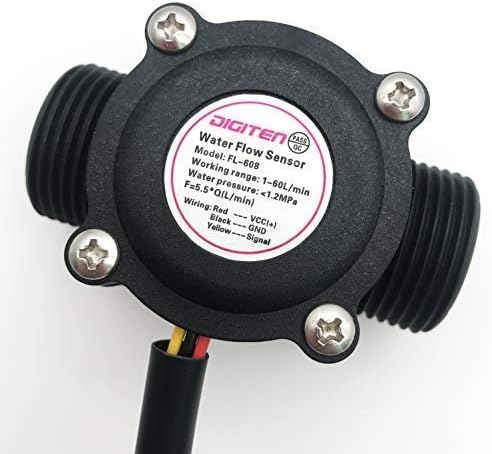
This flow meter stands out with its integrated magnetic hall effect sensor that outputs a pulse for every revolution. Rated at 4.7 stars it delivers reliable data for Arduino or Raspberry Pi projects involving water monitoring.
We may earn a commission when you buy through this link, at no additional cost to you.
The NPT thread makes it easy to install into standard pipes while the sealed sensor keeps electronics dry. Its lightweight design helps maintain system balance without adding unnecessary bulk to your setup.
You must ensure you install it with the correct flow direction or there will be no signal. For high pressure applications the max limit might be lower than industrial units but it fits most hobbyist needs.
Buy this if you need a straightforward sensor for water heaters or dispensers. It offers solid performance and safety for drinking water applications without requiring complex mounting solutions.
The magnetic hall effect sensor ensures every rotation is counted accurately without physical contact wear.
Sensor components are sealed from the water pipe to keep the unit dry and safe long term.
We may earn a commission when you buy through this link, at no additional cost to you.
Rated 4.9 stars this sensor is highly regarded for water testing and cooling systems. It features distinct high and low amplitude thresholds that make signal processing straightforward for developers.
We may earn a commission when you buy through this link, at no additional cost to you.
The strong electric strength rating ensures it can handle voltage spikes better than cheaper alternatives. This reliability makes it suitable for credit card machines or vending applications where uptime matters.
Be aware that the amplitude specs require you to check your controller input levels. If your board expects a different voltage range you might need a signal conditioner to avoid false readings.
Choose this for projects requiring high electrical robustness. Its clear signal output reduces noise and improves the accuracy of your flow calculations significantly.
Distinct high and low voltage thresholds simplify the decoding logic for microcontrollers.
With 1250V/min electric strength it protects the circuit from voltage surges better.
We may earn a commission when you buy through this link, at no additional cost to you.
This is one of the most affordable options in the list with a solid 4.5 star rating. It uses a hall effect sensor to produce a square wave output ideal for counting pulses on GPIO pins.
We may earn a commission when you buy through this link, at no additional cost to you.
Its small size makes it perfect for tight spaces or portable projects. The wide voltage range of 3.5 to 12V means you can run it directly from many batteries or USB sources easily.
The flow range tops out at 10L/min which limits it to smaller water systems. Also the G3/8 thread might require an adapter for standard 1/2 inch pipes you are using.
Pick this if you are building a cost sensitive project like a smart faucet. It balances price and performance well for low flow monitoring tasks.
You get reliable pulse detection and waterproofing at a very competitive price point.
Working from 3.5 to 12V allows flexible power options including battery or USB.
We may earn a commission when you buy through this link, at no additional cost to you.
This sensor holds a perfect 5.0 rating and handles flows from 5 to 150L/min which is rare. Its materials align with ROHS standards making it safe for drinking water in reverse osmosis filters.
We may earn a commission when you buy through this link, at no additional cost to you.
It supports high pressure up to 1.75Mpa and resists heat and cold well. This durability suits industrial or heavy duty commercial applications where standard sensors might fail.
The G1.5 inch thread is quite large so check your pipe diameter before buying. It also carries a higher price than the smaller 1/2 inch options on this list.
Choose this for main water line monitoring or high volume systems. It provides trusted performance where accuracy and flow capacity are critical requirements.
With up to 150L/min this sensor handles high flow rates without losing accuracy.
Materials meet ROHS standards ensuring safe contact with drinking water.
We may earn a commission when you buy through this link, at no additional cost to you.
This sensor uses food grade plastic for all raw materials which is great for beverage or water systems. It outputs a pulse signal with a calculated frequency formula for accurate flow tracking.
We may earn a commission when you buy through this link, at no additional cost to you.
You can run it on DC 5 to 24V making it flexible for different power sources. The BSPT thread ensures a solid connection to standard pipes used in coffee machines or purifiers.
The 4.1 rating is lower than others likely due to basic features or minor fit issues. It lacks the extra cable or premium seal options found in more expensive units.
Buy this if you need a safe water contact sensor on a budget. It works well for coffee machines or basic drinking fountains without premium costs.
All raw materials conform to food grade standards for safe water contact.
Operates from 5V to 24V giving you more power supply options.
We may earn a commission when you buy through this link, at no additional cost to you.
This set includes two sensors with a transparent valve body so you can see the rotor spinning. It runs on DC 3.5 to 24V and uses stainless steel beads in the impeller for durability.
We may earn a commission when you buy through this link, at no additional cost to you.
Being able to see the water flow helps you quickly check for blockages or air bubbles. This is a great feature for testing or debugging your water system setup.
The 3.7 rating suggests some users find the clear plastic fragile or the calibration inconsistent. It is a good value for two units but expect some variance in performance.
Get this for prototyping or educational projects where visual flow confirmation helps. The pair saves you from buying replacements if one fails later.
The transparent body lets you visually confirm water flow and rotor movement easily.
Buying two sensors at once is cost effective if you need spares for testing.
We may earn a commission when you buy through this link, at no additional cost to you.
Designed to connect to a hosepipe with a 5 to 7mm inner diameter this sensor is ideal for low flow tasks. It handles 0.3 to 6L/min which is perfect for drip irrigation or small dispensers.
We may earn a commission when you buy through this link, at no additional cost to you.
The food grade plastic ensures safety for drinking water use. Its 4.2 rating shows decent satisfaction for projects needing a compact sensor that fits in tight spaces.
It has a max pressure of 0.8Mpa which is lower than the larger models. Do not use it on high pressure main lines as it may leak or fail.
Choose this for small scale irrigation or portable water systems. Its size and safe materials make it a practical choice for hobbyist projects.
Connects directly to small hoses without needing complex adapters for setup.
Sensitive enough to detect flow as low as 0.3L/min accurately.
We may earn a commission when you buy through this link, at no additional cost to you.
This sensor has a perfect 5.0 rating and a standard design used in many water heaters. It uses a magnetic rotor that spins with the flow rate to generate a pulse signal.
We may earn a commission when you buy through this link, at no additional cost to you.
The controller can determine flow magnitude from this feedback for regulation. It is straightforward to install at the water inlet end for testing purposes.
It does not offer extra cables or premium housing beyond the basic model. For a standard water dispenser it is sufficient and reliable without complex wiring.
Buy this if you need a trusted sensor for a water heater or dispenser. It balances simplicity and accuracy well for common residential tasks.
A rotating magnetic rotor changes speed with flow to provide accurate feedback.
The pulse signal allows controllers to regulate water flow magnitude precisely.
We may earn a commission when you buy through this link, at no additional cost to you.
This unit includes a 1.2 meter cable which adds flexibility when mounting the sensor. It has a 4.8 rating and uses a SM2.54 3P connector for clean connections to your board.
We may earn a commission when you buy through this link, at no additional cost to you.
The waterproof build and ROHS materials mean it is safe for potable water. You can place it further from your Arduino and run the cable through a panel easily.
The voltage caps at 18V so ensure your power source stays below that limit. The cable length is fixed which might not suit every tight installation space.
Choose this if you need extra reach from the sensor to your controller. It simplifies setup and keeps your wiring tidy for better system organization.
A 1.2 meter cable allows you to mount the sensor away from the main board.
SM2.54 3P connector ensures a neat and secure electrical connection.
We may earn a commission when you buy through this link, at no additional cost to you.
This model offers a flow range up to 60L/min with a G3/4 inch connection for larger pipes. It also includes a 1.2 meter cable like the G1/2 version for flexible mounting.
We may earn a commission when you buy through this link, at no additional cost to you.
It uses ROHS compliant materials for safe contact with drinking water. The waterproof housing protects it from heat cold and pressure up to 1.75Mpa.
The 3.2 rating is the lowest in the list likely due to mixed feedback or fit issues. Some users may find it harder to align with specific plumbing setups.
Consider this if you need a middle ground size between standard and large pipes. It offers useful features like cable extension but at a higher risk of fit.
The G3/4 inch thread fits pipes that are too large for standard sensors.
A 1.2 meter cable adds reach for flexible installation near controllers.
We may earn a commission when you buy through this link, at no additional cost to you.
Choosing the right Arduino Flow Meter depends on your specific project needs. Look at flow range connection type and safety standards to ensure compatibility.
You must match the sensor to your expected water flow speed. Low flow units work best for drinking fountains while high flow ones suit main pipes.
Check the minimum and maximum liters per minute to avoid saturation.
Sensors come in threads like G1/2 or G3/8 which fit specific pipe sizes. Make sure you have the right adapter if your pipe does not match.
A mismatched thread can cause leaks or installation issues.
If you are measuring drinking water look for food grade plastic or ROHS compliance. This ensures no harmful chemicals leach into the water.
Always verify potable water safety for health related projects.
Most sensors output a square wave pulse that the Arduino can count. Check the voltage range to ensure it matches your board or power source.
Ensure the signal is compatible with your interrupt pins.
Higher pressure lines need sensors with a robust pressure rating. Exceeding the max pressure can damage the internal parts.
Verify the Mpa limit before connecting to mains lines.
Some models include a long cable to reach your controller easily. Others require you to solder wires which adds complexity.
Decide based on your mounting distance and skill level.
Install the sensor in the correct flow direction to ensure it generates signals. Most units have an arrow indicating the right way to place it in the pipe.
Connect the signal wire to a digital interrupt pin on your Arduino so it counts pulses accurately. Use a pull-up resistor if your code requires it for stable readings.
Clean the sensor regularly and check for leaks to keep it working well. Avoid using it with liquids that contain particles larger than the rotor clearance.
The best sensor depends on your flow range. For most drinking water or small systems the 1/2 inch models work well. If you need high flow consider the G1.5 inch units for capacity.
It depends on your board and code. Most Arduino pins have internal pull-ups that you can enable. If the signal is noisy add an external resistor for stability.
Many of the models listed use food grade plastic and meet ROHS standards. Always verify the product description for potable water safety before using it for drinking.
Use the frequency factor given in the specs to convert pulses to liters per minute. Your code counts pulses over a time window and then applies the math factor.
Some models support lower voltages like 3.5V while others need 5V. Check the working voltage range to ensure your 3.3V board is within safe limits.
Common sizes are G1/2 and G3/8. Match the thread to your pipe or buy an adapter if they differ. Using the wrong thread can cause leaks.
Accuracy varies by model but many claim a percentage error of around 2 to 3 percent. They are generally accurate enough for hobbyist and basic industrial projects.
They are heat resistant but check the max temperature in the specs. Some models handle warm water well but boiling water might damage the internal plastic parts.
The top picks offer solid reliability for most monitoring tasks. Choose the best budget option for simple needs or the premium choice for larger systems.
Prioritize flow range and connection size to avoid fitting issues later. Safety materials are key if you are measuring drinking water directly.
Remember to check current prices and availability as they change. Review the specs again to confirm it fits your specific project needs.