
Edifier MR3 Powered Studio Monitor
4.5Editor score
Hi-Res Audio Certified
Multiple Input Options
Customizable Sound Modes
This guide compares the top ten Edm Studio Monitor options for producers seeking accurate sound, versatile connectivity, and reliable performance in any home
Finding the right Edm Studio Monitor is essential for any serious music producer or audio enthusiast. These speakers provide the accurate sound reproduction needed to mix tracks with confidence and clarity in your home studio environment.
We evaluated ten top-rated models based on sound quality, build durability, connectivity options, and overall value. Our analysis focuses on real-world performance metrics to help you choose the best tool for your specific production needs and budget.
Each pick below highlights key strengths and potential trade-offs to guide your decision. Note that product availability and pricing can fluctuate over time, so verify current details before finalizing your purchase for your studio.
4.5Editor score

4.8Editor score

4.6Editor score
The following table provides a side-by-side comparison of all ten models reviewed in this guide to help you quickly identify key specifications and features.



The PreSonus Eris E4.5 near field studio monitors deliver studio-quality accurate sound perfect for music production and multimedia reference. With a strong 4.5 rating this model is a top choice for producers needing reliable monitoring.
We may earn a commission when you buy through this link, at no additional cost to you.
Its woven-composite woofers produce tight bass you can feel while maintaining cleaner overall sound. The 1-inch silk-dome tweeters provide superior stereo imaging from nearly any listening angle for accurate mixes.
While the bass is tight deep extension is limited compared to larger models. This is acceptable given the price point and compact design which suits smaller home studios and desks well.
This monitor is ideal for producers prioritizing clarity and connectivity. The front aux input and tuning controls make it versatile for both professional work and casual listening.
The natural high-frequency response of the 1-inch silk-dome tweeters ensures accurate stereo imaging from nearly any listening angle.
High and low-frequency tuning controls allow you to customize your audio output for your ears room size and speaker orientation.
We may earn a commission when you buy through this link, at no additional cost to you.
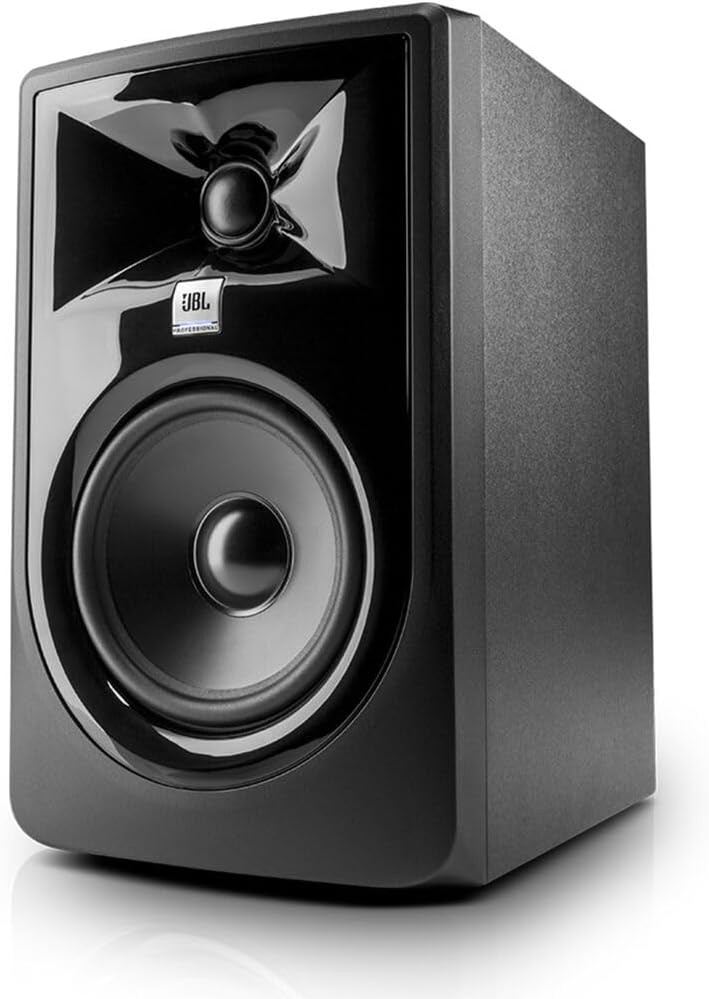
The JBL 305P MkII offers crystal-clear imaging via its patented Image Control Waveguide delivering precise immersive sound for music production and podcasting. Rated 4.7 it stands out for refined audio quality.
We may earn a commission when you buy through this link, at no additional cost to you.
Dual 41-Watt Class-D amplifiers ensure dynamic range and deep bass via a 5-inch woofer. Boundary EQ and HF Trim adjust frequencies to suit any room ensuring accurate mixes for vloggers.
The price is higher than basic speakers but the 70-year expertise ensures robust reliability. Lack of Bluetooth is a minor trade-off for professional XLR TRS inputs and solid MDF enclosure.
Ideal for producers needing accurate mixes on a budget. The wide sweet spot and deep bass make it perfect for cinematic sound design and critical listening sessions.
This technology delivers precise immersive sound with a wide sweet spot ideal for music production and podcasting needs.
Boundary EQ and HF Trim adjust low and high frequencies to suit any room ensuring accurate mixes for producers.
We may earn a commission when you buy through this link, at no additional cost to you.
The Edifier MR3 is Hi-Res Audio Certified delivering a flat response across 52Hz to 40kHz for precise monitoring. With 36 Watts RMS and Bluetooth support it is great for daily listening.
We may earn a commission when you buy through this link, at no additional cost to you.
Balanced TRS RCA and AUX inputs allow simultaneous connections. The EDIFIER ConneX app offers in-depth adjustments and personalized EQ control to suit your needs.
Peak SPL is lower than pro models but sufficient for small rooms. Lack of advanced tuning controls limits fine-tuning for critical mixing tasks.
Perfect for creators needing versatile connectivity. Its Hi-Res certification and app control make it ideal for music creation and everyday listening.
Experience superior sound with certification delivering a flat response across 52Hz to 40kHz for precise monitoring.
Easily switch between Music Monitor and Custom modes with app-based adjustments for personalized EQ control.
We may earn a commission when you buy through this link, at no additional cost to you.
The PreSonus Eris E7 XT features a 6.5-inch woven composite low-frequency transducer giving deep lows and smooth highs via 1.25-inch silk-dome tweeters. Rated 4.8 it excels in accuracy.
We may earn a commission when you buy through this link, at no additional cost to you.
The EBM waveguide yields a wide sweet spot and solid imaging. Acoustic tuning controls allow tailoring the monitor to your space including LF and HF trim.
Packaged as a single unit it requires two for stereo use. It takes more space but the deeper bass suits larger rooms or detailed mixes.
Ideal for those needing deeper lows without buying a subwoofer. Its software bundle and tuning controls add great value for home studios.
The 6.5-inch woofer gives deep lows while the 1.25-inch silk-dome tweeter provides smooth highs.
Innovative EBM waveguide yields a wide sweet spot and solid imaging for accurate monitoring.
We may earn a commission when you buy through this link, at no additional cost to you.
The YAMAHA Hs5 emphasizes sonic purity without coloring the original sound. With 70 watts power amplification it delivers a flat response from 54 hertz to 30 kilohertz.
We may earn a commission when you buy through this link, at no additional cost to you.
Its bi-amp system with 5 inch Cone woofer ensures high performance. XLR and TRS inputs accept balanced signals for professional setups.
Lack of HF trim limits room correction. Basic design lacks modern features but the sound is trusted by producers worldwide.
Perfect for those valuing pure sound. Its bi-amp system makes it a reliable tool for critical mixing.
Monitors emphasize sonic purity without any coloring or alternation of the original sound.
45W LF plus 25W HF bi amp system provides high-performance 70 watts power amplification.
We may earn a commission when you buy through this link, at no additional cost to you.
The Ortizan C7 built with 24-bit DAC captures digital audio minimizing loss for top fidelity. It delivers clear precise sound ideal for monitoring while creating content.
We may earn a commission when you buy through this link, at no additional cost to you.
Carbon fiber speaker and silk dome tweeter provide clean mid-low frequencies. Balanced input connects to mixers for professional setups.
Small driver size limits deep bass. But its professional tuning and HIFI performance suit casual monitoring and gaming.
Ideal for entry-level studios needing clarity. Its versatile inputs make it great for multimedia and simple music production.
Built-in 24-bit DAC captures digital audio directly via USB maximizing sound fidelity for top performance.
After dozens of adjustments it reproduces signals with balanced sound across high mid and low frequencies.
We may earn a commission when you buy through this link, at no additional cost to you.
The KALI AUDIO LP-6 V2 uses a robust DSP for flat response. Rated 4.5 it emits sounds as they are in your mix without alterations.
We may earn a commission when you buy through this link, at no additional cost to you.
12dB noise reduction and low distortion upgrades provide clear sounds. Bi-amped design delivers 80 watts for 115dB max SPL.
Boundary EQ adapts it to any setup. Lack of advanced DSP limits deep customization but performance is astounding for price.
Ideal for producers needing volume and accuracy. Its low noise and powerful output suit larger spaces.
The 2nd gen LP-6 has a more robust DSP system for flat frequency response.
Bi-amped monitor delivers 80 watts with max SPL of 115dB for loud clarity.
We may earn a commission when you buy through this link, at no additional cost to you.
The Edifier MR5 offers a 3-way active crossover with 5 inch woofer 3.75 inch mid driver and 1 inch tweeter. Rated 4.5 it delivers 46Hz–40kHz range.
We may earn a commission when you buy through this link, at no additional cost to you.
Hi-Res Audio supports 24-bit/96kHz LDAC. Room acoustic tuning via knobs or app adjusts sound to your space.
Higher price is justified by premium power and features. Size may be large for small desks but output is robust.
Perfect for pro home studios needing detailed reproduction. Its LDAC and tuning make it versatile for mixing.
Studio-grade sound with 5 woofer 3.75 mid and 1 tweeter for accurate reproduction.
Tailor sound to your space using physical rear knobs or EDIFIER ConneX App.
We may earn a commission when you buy through this link, at no additional cost to you.
The Mackie CR4.5BT combines studio-quality sound with tone control and Bluetooth. It is great for gaming and casual listening with 4.7 rating.
We may earn a commission when you buy through this link, at no additional cost to you.
Tone knob shapes sound and location switch optimizes for desktop or bookshelf. TRS and RCA allow connects to interfaces.
Bass boost makes it less pure but fun. Lack of precision limits critical mixing but suits multimedia.
Ideal for creators needing flexibility. Its tone control and sub readiness make it versatile.
Use tone knob to boost bass or add sparkle for immersive gaming.
Flip switch between desktop mode and bookshelf mode to optimize placement.
We may earn a commission when you buy through this link, at no additional cost to you.
The Yamaha HS8 delivers 38Hz to 30kHz response with 8 inch woofer. Rated 4.6 it uses 75W LF plus 45W HF bi-amp for 120W power.
We may earn a commission when you buy through this link, at no additional cost to you.
Large magnets in advanced magnetic circuit ensure performance. Pairing ensures deep lows and clarity for mixing.
Highest price and large footprint suit dedicated studios. Accuracy justifies cost for professional mixes.
Perfect for professional studios. Its full range and power make it a reliable choice.
38Hz to 30kHz frequency response ensures full-range sound coverage.
75W LF plus 45W HF bi-amp for high-performance 120W power amplification.
We may earn a commission when you buy through this link, at no additional cost to you.
Selecting the right studio monitor requires careful consideration of several factors to ensure accurate sound reproduction and compatibility with your setup.
Driver size significantly impacts low-frequency response. Larger drivers like 8-inch offer deeper bass while smaller ones like 4.5-inch fit compact spaces. Choose based on room size and bass needs.
Select driver size matching your room dimensions and bass requirements for optimal monitoring.
Active monitors have built-in amps simplifying setup. Check wattage to ensure sufficient volume for your space. Passive monitors require external amps adding complexity.
Opt for active monitors with appropriate wattage for your studio size.
Ensure inputs match your interface. Balanced inputs like TRS or XLR reduce noise. Unbalanced RCA suits consumer devices. Consider Bluetooth for versatility if needed.
Verify inputs match your gear and include balanced connections for quality.
Room acoustic tuning controls adjust frequency response to your space. Look for EQ or HF/LF trim to compensate for reflections. This ensures accurate mixes.
Choose monitors with room tuning controls to adapt to your acoustic environment.
Solid cabinets like MDF reduce resonance. Check grill quality and internal damping. Durable construction ensures longevity and consistent sound over time.
Prioritize solid cabinet materials to minimize distortion and resonance.
Flat frequency response ensures accurate sound without coloration. Look for wide range like 40Hz-20kHz. This helps detect flaws in mixes across frequencies.
Ensure flat frequency response for truthful sound reproduction.
Budget determines available features. Higher prices offer larger drivers and better materials. Balance cost with essential needs for professional work.
Balance budget with essential features needed for your production work.
Always buy monitors in pairs for stereo imaging. Ensure both units match specifications for balanced sound. Single units limit spatial accuracy.
Always purchase matched pairs to ensure balanced stereo imaging.
Place monitors at ear level forming an equilateral triangle with your listening position. This ensures optimal imaging and frequency balance. Adjust angles for direct sound.
Use acoustic panels if needed to reduce reflections. Room treatment enhances monitor performance significantly. Keep monitors away from walls to prevent bass buildup.
Clean regularly with dry soft cloth to avoid dust. Avoid direct sunlight and heat sources to protect drivers. Check cables periodically for wear.
For home studios 5 to 6.5 inches work well. Larger 8-inch models suit spacious rooms needing deep bass. Smaller 4.5-inch monitors fit compact desks but lack sub-bass.
Yes most active monitors need an interface for balanced connections like TRS or XLR. Some accept RCA for consumer devices. Ensure your interface has appropriate outputs.
Yes but they prioritize accuracy over coloration. Music may sound flatter than consumer speakers. They are great for critical listening and mixing.
Balanced inputs reduce noise and interference over longer cable runs. They use three conductors to cancel out hum. This is essential for professional audio setups.
Depends on size. Monitors smaller than 7 inches may lack deep bass. Subwoofers extend low end for mixing. Consider based on bass needs.
Check acoustic tuning every six months. Room conditions change over time. Use measurement tools for precise adjustments if available.
This guide presented ten top Edm Studio Monitor models from budget to premium. The PreSonus Eris E4.5 JBL 305P MkII and Yamaha HS8 stand out for accuracy and value.
Prioritize room tuning and balanced inputs for accurate mixes. Ensure the driver size fits your space. Choose based on specific production needs.
Always check current prices and availability before purchasing. Prices fluctuate and models may update. Confirm details ensure you get the best deal for your studio.