
Creality Otter Lite Basic
4.7Editor score
0.05mm high precision
Portable plug-and-play design
Full-color texture mapping
This comprehensive guide compares the top 3D scanners for reverse engineering, evaluating accuracy, speed, and features to help professionals choose the ideal
Selecting the right 3D scanner for reverse engineering requires understanding precision, speed, and material compatibility. Modern tools now handle complex geometries and reflective surfaces with industrial-grade accuracy for reliable results.
We evaluated ten leading models based on laser technology, software integration, portability, and real-world performance. This list covers handheld and stationary options suitable for automotive, manufacturing, and design workflows.
Each pick highlights key strengths and limitations to guide your decision. Prices and availability change frequently, so verify current details before purchasing to ensure you get the best value for your specific needs.
4.7Editor score

4.8Editor score

4.9Editor score
This side-by-side comparison highlights the core specifications and capabilities of each model to help you quickly identify the scanner that aligns with your reverse engineering requirements.



The Revopoint MetroX Pro stands out as a top choice for reverse engineering due to its industrial-grade blue laser scanning and 0.01mm single-frame precision. It captures detailed geometries and dimensions flawlessly, meeting the rigorous demands of precision modeling and industrial measurement tasks.
We may earn a commission when you buy through this link, at no additional cost to you.
Its four scanning modes including cross-line lasers and full-field structured light enable efficient capture of flat, shiny, or dark surfaces without spray. The auto turntable mode simplifies complex object scanning, while real-time streaming enhances workflow efficiency by allowing mobile monitoring.
Although the software suite requires Windows and some tools are sold separately, the scanner's reliability and accuracy justify the investment. Users benefit from consistent volumetric accuracy and robust feature tracking modes that support a wide range of industrial and design applications.
This model is ideal for professionals seeking metrology-level precision in a handheld form factor. The combination of speed, accuracy, and ease of use makes it a reliable tool for reverse engineering, quality inspection, and 3D printing workflows.
With single-frame precision up to 0.01mm and volumetric accuracy of 0.02mm + 0.04mm × L (m), the MetroX Pro delivers data suitable for high-stakes engineering and inspection tasks.
Cross-line and parallel line laser modes allow direct scanning of shiny or dark surfaces without spray, saving time and preserving delicate parts during reverse engineering projects.
We may earn a commission when you buy through this link, at no additional cost to you.
The Revopoint MetroY Ultra is engineered for high-throughput environments, offering up to 90 FPS scanning with NVIDIA GPUs. Its industrial-grade accuracy of 0.01mm precision makes it ideal for reverse engineering, tight tolerance measurement, and industrial inspection tasks.
We may earn a commission when you buy through this link, at no additional cost to you.
Five versatile scanning modes handle everything from small parts to medium objects, while outdoor compatibility up to 100,000 lux ensures reliable performance in harsh lighting. The included 5500 mAh battery grip supports extended field work without power outlets.
While its premium price and GPU requirements may limit some users, the speed and wireless flexibility provide significant productivity gains. Export to major industry formats like PLY, OBJ, and STL ensures seamless integration with CAD software.
This scanner is best for professionals needing fast, accurate data capture in diverse environments. The combination of speed, battery life, and wireless connectivity makes it a powerful tool for dynamic reverse engineering workflows.
With up to 90 FPS scanning and 34-laser cross-line mode, the MetroY Ultra drastically reduces acquisition time without compromising data quality for large-area scans.
Wi-Fi 6 support and sunlight-compatible laser modes allow free movement and reliable scanning outdoors, enhancing portability for field-based reverse engineering tasks.
We may earn a commission when you buy through this link, at no additional cost to you.
The EinScan Rigil offers a seamless wireless all-in-one scanning solution with onboard computing and Wi-Fi 6 connectivity. Its hybrid blue laser plus IR VCSEL technology achieves 0.04mm accuracy and captures vibrant textures with a 5MP camera for high-fidelity reverse engineering.
We may earn a commission when you buy through this link, at no additional cost to you.
Equipped with a powerful 2.4GHz CPU, 32GB RAM, and 1TB SSD, the Rigil ensures smooth processing and fast workflow. The replaceable batteries and sunlight compatibility enable scanning anywhere, while the AMOLED touchscreen enhances usability in the field.
Though expensive, its ability to scan dark and reflective surfaces without spray reduces prep time and protects delicate components. The included accessories and online training provide a complete package for immediate deployment in automotive and design applications.
This premium scanner is ideal for teams needing autonomous, high-performance tools. Its speed, accuracy, and portability make it a top choice for complex reverse engineering and prototyping projects requiring minimal setup.
Hybrid blue laser and IR VCSEL with 50 laser lines deliver ultra-precise accuracy and high-definition texture capture ideal for automotive and engineering use cases.
Onboard computing and replaceable batteries allow standalone scanning without cables or external PCs, enhancing portability for on-the-go reverse engineering work.
We may earn a commission when you buy through this link, at no additional cost to you.
The Creality CR-Scan Raptor Pro features 22 crossed blue lasers and 7 parallel lines, achieving 0.02mm accuracy with up to 660,000 dots per second. It handles objects from 5mm to 4000mm, making it suitable for automotive modification and reverse engineering applications.
We may earn a commission when you buy through this link, at no additional cost to you.
Blue laser technology eliminates spray needs for black and metal objects, while infrared structured light supports feature-rich scans. Multi-mode scanning and anti-shock algorithms ensure stable workflows, with true-color rendering for realistic models.
Despite minor software compatibility concerns on older systems, its versatility and high frame rate offer strong value. Cross-platform support allows seamless integration with industry tools like Geomagic and SolidWorks for smooth post-processing.
This model is perfect for professionals needing flexible scanning across sizes. Its accuracy, speed, and no-spray operation make it a reliable tool for detailed reverse engineering and design tasks.
Supporting sizes from 5mm to 4000mm, the Raptor Pro adapts to everything from small components to large automotive parts for diverse reverse engineering needs.
Blue and infrared laser modes scan black and metal objects without spray, while 60fps ensures efficient capture of surface details for faster workflows.
We may earn a commission when you buy through this link, at no additional cost to you.
The Revopoint INSPIRE 2 is a lightweight 190g handheld scanner with 0.05mm accuracy and dual scanning modules for structured light and laser modes. It captures true-to-life colors and supports outdoor scanning up to 20,000 lux for versatile use.
We may earn a commission when you buy through this link, at no additional cost to you.
Its optical zoom allows focusing on mixed-geometry surfaces, while Wi-Fi 6 enables real-time mobile streaming. Calibration tools and intuitive software ensure consistent data ready for reverse engineering and 3D printing workflows.
Though not as precise as industrial models, its affordability and portability make it ideal for hobbyists and small businesses. The included accessories and full-color texture capture add value for detailed modeling tasks.
This scanner suits users seeking cost-effective reverse engineering tools. Its balance of speed, weight, and accuracy provides a practical entry point for professional-grade scanning needs.
Weighing only 190g with aerospace-grade aluminum, the INSPIRE 2 is easy to carry and use for extended scanning sessions in various environments.
Adjustable optical zoom focuses on surface details across various object sizes, improving accuracy and texture capture for precise reverse engineering data.
We may earn a commission when you buy through this link, at no additional cost to you.
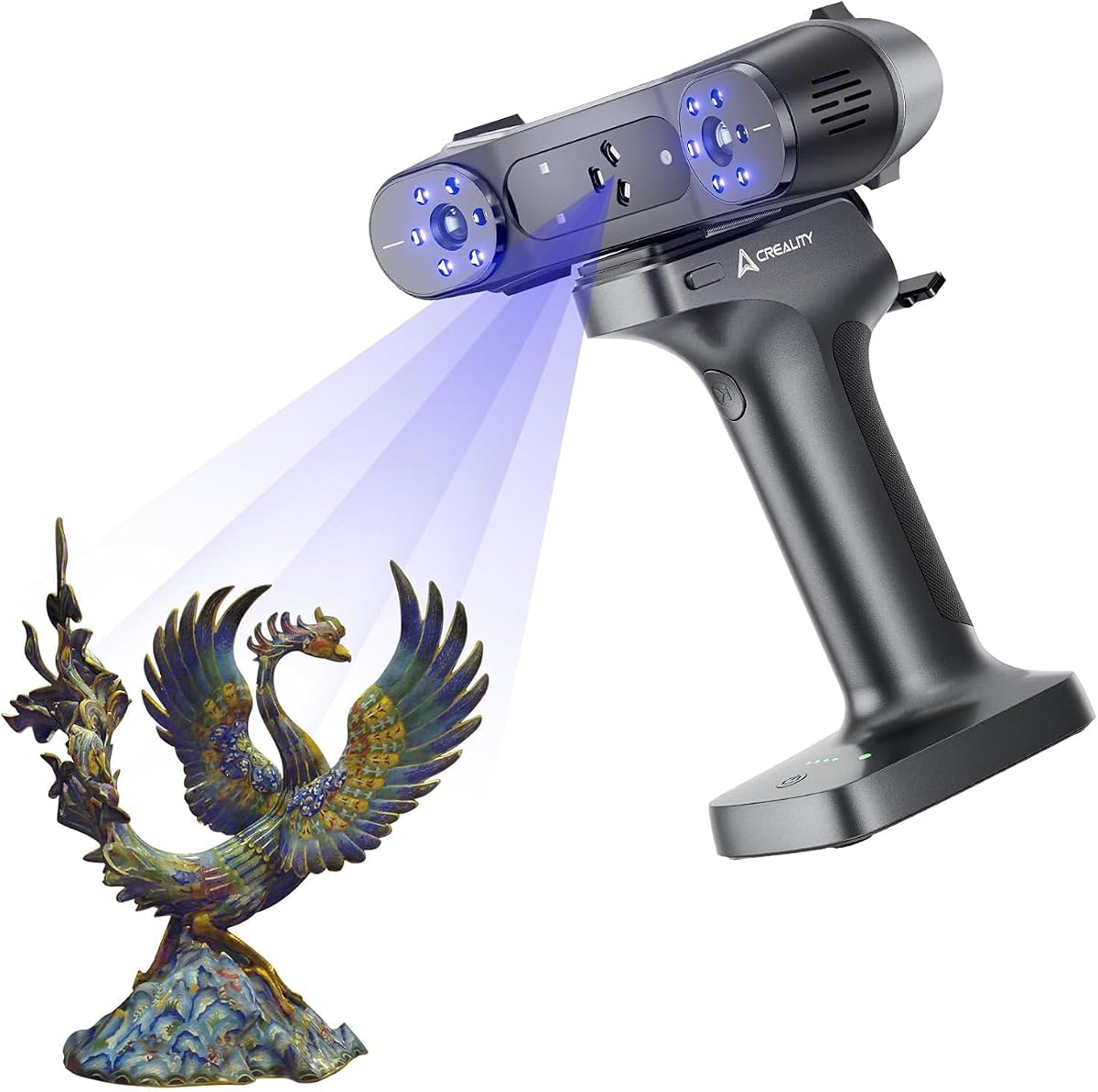
The Creality Otter Lite Basic delivers 0.05mm precision with dual close-range and long-range modes, capturing objects as small as 20mm. Its RGB and infrared cameras produce true-to-life color textures for 3D printing and reverse engineering tasks.
We may earn a commission when you buy through this link, at no additional cost to you.
Weighing 235g with plug-and-play USB connectivity, it is highly portable. The kit includes a turntable, calibration board, and carrying case, offering everything needed to start scanning immediately without additional purchases.
While less precise than high-end tools, it provides solid accuracy for DIY and entry-level projects. Compatible with Windows and macOS, its simple interface and LED guidance ensure an accessible experience for beginners.
This model is perfect for hobbyists and small workshops needing cost-effective reverse engineering. Its ease of use and included accessories make it an excellent value for portable 3D scanning.
Supporting close-range 100–200mm and long-range 250–1500mm modes, it captures fine details on small objects while adapting to larger items with ease.
The package includes a turntable, calibration board, markers, and case, allowing users to start scanning out of the box without extra setup.
We may earn a commission when you buy through this link, at no additional cost to you.
The Revopoint MetroX Pro Standard offers 0.02mm single-frame accuracy with industrial blue laser scanning and four modes including auto turntable. It handles shiny and dark surfaces without spray, ideal for precision modeling and reverse engineering.
We may earn a commission when you buy through this link, at no additional cost to you.
Real-time PC-to-mobile streaming and intuitive Revo Metro software streamline workflows. The HD RGB camera ensures color-accurate scans, while tracking modes support a wide range of object types and inspection tasks.
Though software is Windows-only and some tools are separate, the scanner's precision and ease of use provide strong value. Its volumetric accuracy meets industrial standards for reliable measurements and CAD-ready models.
This model suits engineers and designers needing consistent high-quality data. Its combination of accuracy, automation, and color capture makes it a dependable choice for reverse engineering applications.
With up to 2,000,000 points per second and 0.02mm accuracy, the MetroX Pro Standard ensures rapid capture of detailed surface data for efficient workflows.
The dual-axis turntable enables one-click scans, while the RGB camera captures vivid color accurately for realistic 3D models and enhanced visual inspection.
We may earn a commission when you buy through this link, at no additional cost to you.
The Creality CR-Scan Raptor Pro delivers metrology-grade accuracy of 0.02mm with 22 crossed blue lasers and 7 parallel lines. Its outdoor-ready design withstands up to 100,000 lux, while no-spray scanning protects delicate industrial components.
We may earn a commission when you buy through this link, at no additional cost to you.
Software includes one-click processing and face and body modes for rapid human scans. Compatible with Windows and macOS, it supports export to standard formats for seamless CAD integration in reverse engineering workflows.
Despite higher system requirements, its robust features ensure high-quality results. The anti-shake algorithms and adaptive scanning modes enhance stability, making it reliable for complex objects and industrial design tasks.
This scanner is ideal for professionals needing accurate outdoor and indoor performance. Its versatility and metrology-grade precision make it a strong choice for automotive and engineering reverse engineering.
With 0.02mm volume accuracy and advanced laser configuration, the Raptor Pro captures intricate details for precise reverse engineering and quality inspection.
Laser modes withstand high sunlight exposure, enabling accurate outdoor scanning without sacrificing precision for flexible field work and industrial tasks.
We may earn a commission when you buy through this link, at no additional cost to you.
The Creality Raptor X offers 0.02mm accuracy with 34 cross blue lasers and wireless handle via Wi-Fi 6. It scans objects from 5mm to 4000mm with 60fps and full 24-bit color, ideal for reverse engineering and automotive applications.
We may earn a commission when you buy through this link, at no additional cost to you.
With speckle matching technology and anti-shake support, it captures detailed workpieces without markers. A large 35400mWh battery and fast charging ensure uninterrupted field work, while face and body modes enable quick human scans.
Though system requirements are high, its performance and portability justify the investment. Real-time mirroring allows monitoring from a phone, and export formats support compatibility with standard CAD tools for seamless workflows.
This scanner is suited for professionals needing wireless freedom and high precision. Its speed, accuracy, and color fidelity make it a top choice for detailed reverse engineering and design tasks.
Wi-Fi 6 with lossless compression enables low-latency transfer, while 34 laser lines ensure rapid and accurate capture of medium to large objects.
The large capacity battery provides extended operation with fast charging, allowing users to scan continuously in outdoor or mobile environments without interruption.
We may earn a commission when you buy through this link, at no additional cost to you.
The Creality Raptor Pro delivers 0.02mm metrology-grade accuracy with advanced blue laser technology and NIR structured light. Its wireless support and 660,000 points/s speed make it ideal for reverse engineering and industrial inspection tasks.
We may earn a commission when you buy through this link, at no additional cost to you.
Dual blue laser modes provide comprehensive coverage for medium and large objects, while NIR allows markerless feature-rich scans. Face and body algorithms enable quick human scanning, with software that supports multi-project stitching and real-time previews.
While system requirements are notable, its precision and compatibility with Windows and macOS ensure broad usability. Adjustable resolution settings and post-processing tools facilitate seamless workflows from scanning to CAD design for complex projects.
This scanner is best for professionals requiring high accuracy and speed. Its dual laser system and robust software features make it a powerful tool for reverse engineering and automotive design applications.
Upgraded 22 cross and 7 parallel blue laser lines capture sharp edges and details, while NIR structured light enables markerless scans for faster workflows.
Compatible with Windows and macOS, the CrealityScan software provides multi-project stitching and real-time previews for smooth post-processing and CAD export.
We may earn a commission when you buy through this link, at no additional cost to you.
Selecting a 3D scanner for reverse engineering involves balancing accuracy, speed, and workflow compatibility. These factors ensure reliable results across industrial, design, and prototyping applications.
Accuracy determines how closely scanned data matches real-world dimensions, critical for reverse engineering. Look for scanners with single-frame precision below 0.05mm and volumetric accuracy that scales with object size for reliable measurements.
Prioritize models with metrology-grade precision if your work involves tight tolerances or functional prototyping.
Blue and infrared lasers handle reflective or dark surfaces without spray, saving prep time. Structured light offers speed for large objects, while hybrid systems improve versatility for complex materials and geometries.
Choose scanners with multiple laser lines or hybrid sources for flexibility across different surface types.
Higher frame rates and point capture speeds reduce workflow time. For detailed parts, aim for at least 60fps or 500,000 points per second to balance speed and detail resolution without compromising quality.
Fast scanners increase productivity in high-volume reverse engineering tasks.
Compatible software should support your CAD tools, offer point cloud editing, and allow export to formats like STL or OBJ. Check if additional modules for reverse engineering are included or cost extra to avoid surprises.
Select platforms with intuitive interfaces and seamless integration into your existing design pipeline.
Handheld scanners with batteries enable field work. Consider weight, battery life, and wireless connectivity like Wi-Fi 6 for mobility without cables. Outdoor models should withstand sunlight exposure for reliable performance.
Lightweight, wireless units are essential for mobile or on-site reverse engineering tasks.
Ensure the scanner can capture shiny, dark, or textured surfaces without markers or spray. This reduces preparation steps and protects delicate components during reverse engineering projects.
Models with advanced algorithms for challenging materials improve usability across diverse parts.
Prices vary widely, so match features to your needs. Entry-level scanners may suffice for basic prototyping, while industrial models justify costs with higher precision and automation for professional workflows.
Balance upfront cost with long-term value and required accuracy for your projects.
Powerful PCs with dedicated GPUs and sufficient RAM are often needed for high-speed scanning. Verify compatibility with your current hardware to avoid performance bottlenecks during processing and modeling.
Ensure your workstation meets software specs for smooth and efficient scanning workflows.
Start by calibrating the scanner using the included board to ensure accuracy. Follow the manufacturer’s guidelines for alignment and lighting conditions to optimize capture quality and prevent data errors.
Move the scanner smoothly around the object, maintaining consistent distance and speed for complete coverage. Use markers or turntables when scanning reflective or featureless parts to improve tracking and alignment.
Store the scanner in a protective case when not in use and keep lenses clean with a soft cloth. Regularly update firmware and software to maintain performance and access new features for your workflow.
A scanner suitable for reverse engineering must offer high accuracy, typically below 0.05mm, and handle various surface types without spray. It should integrate with CAD software and capture detailed geometry for precise modeling.
Not all scanners handle reflective or dark surfaces well. Models with blue laser or hybrid light sources often perform better without needing spray or markers to achieve clean data capture.
Software integration is critical, as it allows seamless export to CAD tools like SolidWorks or Geomagic. Ensure the scanner’s software supports necessary formats and offers editing tools for efficient workflows.
Yes, many modern handheld scanners are outdoor-ready with sunlight-compatible lasers. Look for models rated for high lux levels to maintain accuracy in varied lighting conditions.
A turntable is useful for automating scans of rotational or complex parts, reducing manual movement errors. Some scanners include this feature or offer auto modes for efficient reverse engineering.
Processing scan data typically requires a PC with a dedicated GPU, at least 16GB RAM, and a fast multi-core CPU. Higher resolutions and larger datasets benefit from stronger configurations for smooth workflows.
Maintain your scanner by cleaning lenses regularly, storing it in a protective case, and keeping firmware updated. Proper care ensures consistent accuracy and extends the device’s lifespan.
Prices range from budget-friendly entry models to high-end industrial tools. Many mid-range scanners offer sufficient accuracy for reverse engineering without needing the most expensive professional equipment.
This guide highlighted ten top scanners, with the Revopoint MetroX Pro, Creality Otter Lite Basic, and EinScan Rigil standing out for their accuracy, affordability, and wireless performance across diverse workflows.
Prioritize accuracy, software compatibility, and surface handling based on your project needs. Whether you require industrial precision or portable speed, selecting the right features ensures efficient reverse engineering results.
Always verify current prices and availability before purchase, as models and offers change frequently. Investing in a reliable scanner tailored to your workflow will streamline your reverse engineering tasks effectively.