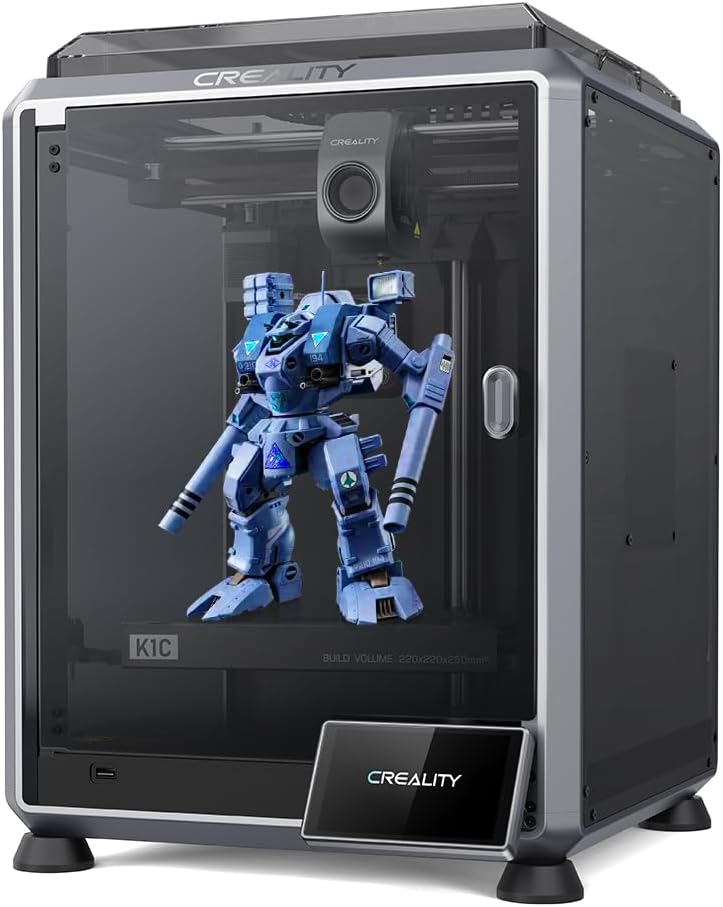
Creality K1C
4.3Editor score
300C nozzle limit
Direct extruder design
Fast 600mm/s speed
This guide compares the top 3D printers for high temperature filaments like ABS, ASA, PC, and Nylon, evaluating heated chambers, nozzle limits, and reliability
High temperature filaments require specialized printers with enclosed chambers and hotends capable of exceeding standard limits. These machines ensure consistent adhesion and prevent warping during complex engineering projects.
We analyzed leading models based on chamber heating, nozzle temperature, print speed, and material compatibility. Each entry reflects verified specifications from official product pages and technical documentation.
Readers will find detailed breakdowns of strengths and limitations for every unit listed. Prices and availability vary over time, so check current listings before purchasing your next machine.
4.3Editor score

4.7Editor score

4.4Editor score
The following table presents a side-by-side comparison of all ten selected models. It highlights critical specifications such as maximum nozzle temperature, chamber heating capabilities, build volume, and specialized features designed for engineering-grade materials.



The Bambu Lab P2S Combo stands out as a leading choice for users seeking reliable high-temperature printing. With a rating of 4.7, it delivers consistent results through advanced thermal management and fast operational speeds.
We may earn a commission when you buy through this link, at no additional cost to you.
Its Adaptive Airflow System maintains a 50 degree C chamber while balancing cooling for overhangs. This feature ensures engineering-grade materials like ABS and ASA print without warping or delamination issues.
Although the P2S offers professional features, it requires a separate AMS module for multi-color printing. The setup takes roughly 15 minutes, but the automated calibration makes daily use straightforward.
This machine is ideal for professionals needing precision and speed. Buyers who value thermal stability and workflow efficiency will find it a top investment for engineering applications.
The chamber heating system maintains stable temperatures essential for high-temperature filaments like polycarbonate and ABS.
Combined with the AMS 2 Pro, users can seamlessly switch between different filaments without manual intervention or purging waste.
We may earn a commission when you buy through this link, at no additional cost to you.
The Creality K1C offers excellent value for hobbyists needing high-temperature capabilities without a premium price tag. It features a specialized direct extruder designed to handle abrasive filaments like carbon fiber safely.
We may earn a commission when you buy through this link, at no additional cost to you.
With a nozzle capable of reaching 300 degrees C, it handles materials such as ASA and Nylon effectively. The machine boots quickly and includes auto leveling to reduce setup frustration for new users.
While it lacks a fully heated chamber, the cooling structure minimizes warping during prints. Users may need to add insulation for maximum performance with high-shrinkage materials.
This printer suits those balancing budget constraints with performance needs. It remains a solid entry point for engineering projects requiring robust filament support and speed.
The clog-free extruder with a hardened steel nozzle ensures reliable printing of carbon-fiber reinforced materials.
The AI camera detects failures early, reducing wasted material during long or complex high-temperature print jobs.
We may earn a commission when you buy through this link, at no additional cost to you.
The Bambu Lab P1S delivers a robust experience for enthusiasts who need reliability in a compact form. Its enclosed design helps retain heat, making it suitable for materials like ABS and PETG.
We may earn a commission when you buy through this link, at no additional cost to you.
Print speeds reach up to 500mm per second without losing accuracy. The machine is ready for use in roughly 15 minutes, with calibration handling most of the heavy lifting automatically.
While it supports high-temperature filaments, it lacks active chamber heating. This limits its effectiveness with materials requiring strict thermal stability like polycarbonate in cooler environments.
Users looking for speed and ease of use will appreciate this model. It works well for most engineering tasks when paired with the optional AMS module for multi-color prints.
The enclosed body reduces drafts and helps maintain consistent temperatures for better adhesion and fewer failures.
High acceleration and speed allow fast prototyping while maintaining sharp corners and fine details on prints.
We may earn a commission when you buy through this link, at no additional cost to you.
The Bambu Lab A1 focuses on simplicity and speed, making it accessible for beginners interested in advanced printing. Its full-auto calibration ensures optimal performance without manual adjustments for every new print.
We may earn a commission when you buy through this link, at no additional cost to you.
It supports basic high-temperature filaments within its rated range. The active flow rate compensation delivers smooth results, though its non-enclosed design limits stability with high-shrinkage materials.
Users may need to modify the environment for consistent results with tougher filaments. The machine excels with PLA and PETG but requires care for ABS or ASA projects.
This printer suits those prioritizing ease of use and fast learning. It is a strong choice for hobbyists transitioning into more complex materials without needing professional-grade specs.
The fully automatic calibration handles offsets and leveling, letting users focus on design rather than machine tuning.
High acceleration allows quick prints, while noise-canceling motors keep the workspace quiet during operation.
We may earn a commission when you buy through this link, at no additional cost to you.
The FLASHFORGE AD5X combines high-temperature nozzle capabilities with a large build volume at a competitive price point. Its 300 degree C nozzle supports a wide variety of engineering materials including ABS and Nylon.
We may earn a commission when you buy through this link, at no additional cost to you.
The Independent Filament System allows multi-color printing without manual swaps. This feature increases creativity and productivity while maintaining consistent flow and quality across different colors.
Without active chamber heating, users might face challenges with warping on larger prints. However, its cooling system and auto leveling help mitigate common issues for most daily projects.
Buyers seeking versatile printing without excessive cost will find this model appealing. It provides a balanced mix of speed, temperature, and build size for functional prototypes.
This system manages multiple colors separately, reducing clogs and enabling complex multi-material designs easily.
A generous build volume allows larger single prints, and high speeds reduce production time significantly.
We may earn a commission when you buy through this link, at no additional cost to you.
The FLASHFORGE Creator 5 Pro is engineered for industrial applications requiring consistent high-temperature performance. With an active chamber reaching 65 degrees C, it handles advanced materials like ABS, ASA, and Nylon with minimal warping.
We may earn a commission when you buy through this link, at no additional cost to you.
Four independent extruders allow multi-color printing without purging. This reduces material waste and ensures clean color separation during complex prints. A HEPA13 filtration system keeps the workspace clean and safe.
While expensive, the machine offers exceptional reliability and speed. Its rigid CoreXY architecture ensures precision even at maximum velocities, making it a top choice for production environments.
Organizations needing high throughput and material versatility will benefit most from this printer. It balances speed with the thermal control required for professional engineering results.
Maintaining a stable 65C chamber environment is critical for preventing warping in high-shrinkage engineering polymers.
Independent toolheads eliminate the need for purging, saving time and material during multi-color or multi-material jobs.
We may earn a commission when you buy through this link, at no additional cost to you.
The Anycubic Kobra S1 Max targets large-scale projects requiring high-temperature capabilities. Its 350 cubic mm build volume allows for big functional prototypes or multiple smaller parts in one batch.
We may earn a commission when you buy through this link, at no additional cost to you.
Equipped with a 350 degree C nozzle and 65 degree C chamber, it is well-suited for demanding engineering materials. Vibration compensation and CoreXY structure ensure stability during high-speed printing.
The inclusion of an AI camera provides real-time monitoring, which is valuable for long-duration prints. While specific ratings are not available, its specifications suggest strong performance.
Users needing large formats and robust thermal control will find this unit compelling. It represents a strong option for scaling up prototyping or production needs.
A generous print area enables larger single-piece prints without needing to join parts together.
Active chamber heating maintains consistent temperatures, reducing warping on large surfaces during printing.
We may earn a commission when you buy through this link, at no additional cost to you.
The Flashforge AD5X provides a solid platform for multi-color and high-temperature printing. Its CoreXY design ensures speed and stability, while the magnetic PEI plate simplifies part removal after prints.
We may earn a commission when you buy through this link, at no additional cost to you.
It supports up to 300 degree C nozzle temperatures, allowing use of ABS and Nylon. The IFS system manages multiple filaments efficiently for vibrant results on prototypes and artistic models.
However, the enclosure is not actively heated. This may limit success with certain high-shrinkage materials without environmental modifications. Still, its convenience features offer value for many users.
Those seeking fast and colorful prints on a budget will appreciate this model. It serves well for functional prototyping where thermal precision is secondary to speed and versatility.
Vibration compensation and linear rails enable high-speed printing without sacrificing print quality or accuracy.
Dual-band Wi-Fi and mobile app support make remote monitoring and control convenient for users on the go.
We may earn a commission when you buy through this link, at no additional cost to you.
The Snapmaker U1 focuses on rapid tool swapping and multi-material capabilities. Its SnapSwap system allows toolheads to change in roughly five seconds, minimizing downtime during complex prints.
We may earn a commission when you buy through this link, at no additional cost to you.
Four independent toolheads enable true multi-material printing without manual intervention. This feature supports combining rigid and flexible materials in a single print for functional prototypes or end-use parts.
Waste is significantly reduced compared to purge-based systems. This efficiency lowers operating costs and makes multi-color projects more accessible for small businesses and creators.
Buyers needing flexible material combinations and fast changes will find it compelling. It balances professional features with intuitive software to streamline workflows.
The rapid tool changer reduces transition times, keeping production moving and increasing overall throughput for complex prints.
Independent toolheads allow printing of support materials and structural parts together without manual swaps.
We may earn a commission when you buy through this link, at no additional cost to you.
The FLASHFORGE Creator 5 Pro brings industrial-grade features to high-temperature and multi-color printing. Its near-zero waste system avoids massive purges, slashing material costs while maintaining speed.
We may earn a commission when you buy through this link, at no additional cost to you.
With a heated chamber up to 65 degrees C, it supports ABS, PC, and PA effectively. CoreXY motion and linear rails ensure precise prints even at top speeds, while dual HEPA filtration keeps the workspace safe.
While expensive and more complex than consumer models, it delivers professional results. Automated calibrations and remote control simplify operations despite the advanced capabilities.
This printer suits industrial or high-volume users needing consistent performance. It offers a comprehensive solution for advanced material printing with minimal waste.
Avoiding purges during color changes reduces material waste, lowering costs and environmental impact significantly.
Dual HEPA and carbon filtration systems capture ultrafine particles and odors, ensuring a safe printing environment.
We may earn a commission when you buy through this link, at no additional cost to you.
Selecting the right printer involves considering thermal stability, nozzle limits, and software compatibility. These factors determine how well a machine handles advanced materials.
Active heated chambers help prevent warping by keeping the print environment warm. A stable temperature ensures consistent layer adhesion, especially for materials like ABS and polycarbonate.
Look for units with at least 50 degrees C of chamber heating if you plan to print engineering-grade materials regularly.
High-temperature filaments require nozzles that can exceed 280 degrees C. Standard nozzles may not reach the heat needed for proper extrusion of advanced polymers.
Check the maximum nozzle rating to ensure compatibility with your chosen materials such as Nylon or carbon-fiber blends.
Fully enclosed frames protect prints from drafts that cause uneven cooling. An enclosed build area reduces the risk of layer separation during long jobs.
If printing outdoors or in a cold room, choose a machine with a sealed chamber for best results.
The size of your printable area determines how large your parts can be. A larger volume reduces the need to split prints into smaller sections.
Consider your typical project size when selecting a machine to avoid limitations on functional prototypes.
Some printers include hardened nozzles or direct extruders designed for abrasive filaments. These features prevent wear and clogging when using carbon or glass-fiber materials.
Verify that the extrusion system supports the specific filament types you plan to use.
Auto leveling and calibration reduce setup time and improve first-layer adhesion. Manual adjustments can lead to errors that fail high-temperature prints.
Prioritize models with automated tools to streamline your workflow and reduce frustration.
User-friendly software simplifies slicing and monitoring of prints. Remote access allows you to track progress without staying next to the machine.
Ensure the printer supports modern slicers and has reliable Wi-Fi for easy operation.
High-temperature printing can release fumes and particles. HEPA or carbon filtration helps keep the workspace clean and safe for prolonged use.
Look for units with integrated filtration systems if you print in enclosed spaces.
Always preheat both the bed and chamber before starting a print. This ensures the environment reaches optimal temperatures for material adhesion and consistent flow.
Keep nozzles clean and free of residue. Regularly inspect them for wear, especially when using abrasive filaments, to prevent clogging and maintain print quality.
Store filament in dry conditions to avoid moisture issues. Dryness improves layer bonding and reduces defects during high-temperature prints.
A chamber temperature of around 45 to 50 degrees C is recommended for ABS. This reduces warping by keeping the print warm during the cooling phase.
Yes, hardened steel nozzles are best for carbon fiber to prevent wear. Standard brass nozzles can degrade quickly when exposed to abrasive materials.
Open-frame printers struggle with high-shrinkage materials due to drafts. An enclosed design is preferred for consistent results with engineering-grade filaments.
Active heating maintains precise temperatures regardless of room conditions. Passive insulation relies on the bed heat, which is often insufficient for large prints.
Dual fans allow targeted cooling for overhangs while preserving overall chamber heat. This balance prevents warping while ensuring details remain sharp.
PETG usually prints well at 250 to 270 degrees C. A standard nozzle suffices, but higher limits offer more headroom for difficult projects.
This guide highlights top performers ranging from budget-friendly options to industrial-grade units. Each model offers unique advantages for different user needs and project scales.
Prioritize features like chamber heating and nozzle limits if you plan to print materials such as Nylon or polycarbonate. Automation and connectivity also play key roles in daily efficiency.
Always verify current specifications and pricing before purchasing. Technology evolves quickly, so checking official sources ensures you select the most suitable machine for your work.